Search

Powered by Blogger.

Networked Blogs

Showing posts with label economical. Show all posts

Sunday, February 17, 2013

Frugal Versus Cheap

Frugality has become very popular over the last several years due to the economy, job market, and rising cost of things like groceries and utilities.  A change in a person's living situation, or simply a desire to be debt free or spend less can set off a chain of events that lead to an examination of lifestyles and ways that money is being spent.  Frugality is a mindset.  It is a way to look at the money you have available to you, what you desire in your life, and using your resources wisely.  Unfortunately, sometimes, people can become overzealous with their frugality and go over to cheap.  What's the difference?  For some people, it's semantics.  One person's cheap is the other person's frugal.  My personal definition of cheap is when your actions take away from others or from your or someone else's quality of life.  While it's great to save, moderation in all things is best.  

So how do you know the difference?  Here are some examples below: 


Frugal:  Buying paper towels on sale with a coupon.
Cheap:  Hanging up paper towels to dry that have been used for “wet only” items.

Frugal:  Using a 2-for-1 coupon to purchase meals at a restaurant or splitting a meal.
Cheap:  Failing to tip the server or only tipping for the 1-meal price.

Frugal:  Using wrapping paper from the dollar store or buying it on sale after Christmas and storing it.
Cheap:  Using birthday, wedding, or happy anniversary wrapping paper for Christmas because you’re too cheap to buy more. 

Frugal:  Having a pot luck meal, making the main entrée, and asking others to bring sides. 
Cheap:  Having a pot luck meal and assigning things to bring so that you don’t have to do anything except set the table…. And then keeping the leftovers. 

Frugal:  Agreeing to dinner and then splitting the tab.
Cheap:  Agreeing to split a dinner tab but ordering an expensive meal, drinks, appetizer, and dessert while the other person bought an inexpensive entrée and drank water.  

Frugal:  Purchasing an outfit on sale, at a thrift store, or by using a discount coupon.
Cheap:  Buying an expensive outfit, wearing it, and then returning it to the store.

Frugal:  Agreeing to carpool to an event and splitting the cost of gas.   
Cheap:  Agreeing to a carpool and then not chipping in for gas when everyone else does.

Frugal:  Buying vegetables on sale or that are marked down and close to their expiration date to be used immediately.
Cheap:  Going home and exchanging your fresh vegetables you just bought for ones that are starting to go bad and then taking them back to the store and demanding a refund, claiming your fresh veggies went bad too quickly.

Frugal:  Buying an item on sale, and enjoying it to its fullest extent, being sad if that item tears up or becomes defective after receiving a lot of use from the item.
Cheap:  Buying an item, using it well, then having it tear up.  Going into a store, buying the same item but repacking the well-used and broken item in the box, claim it’s defective, and then demanding your money back.

Frugal:  Saving leftover condiment packages such as ketchup, mustard, hot sauce, etc., from carryout or drive through meals for later use (i.e., items that were voluntarily given to you along with your meal).
Cheap:  Entering a restaurant and stuffing your pockets with sugar, salt, pepper, plastic utensils, napkins, ketchup packets, hot sauce packets, etc. (i.e., not given to you but offered to go along with meals in a restaurant and putting the restaurant at a disadvantage by taking them). 

Frugal:  Using coupons to get discounts at a restaurant.
Cheap:  Going to a restaurant and asking the cashier to use coupons other people have turned in.   

Frugal:  Learning to cut your family's hair. 
Cheap:  Taking your kids to free haircut days at JCPenney, having the kids' heads shaved so they can go 3 months without having a haircut, and then failing to tip the hair stylist. 


These are but a few very real examples of things that people have done in the name of saving money.  You have to decide for yourself how far you are willing to go to save money, but keeping the above examples in mind can help decide if you're being truly frugal or cheap. 

Saturday, February 9, 2013

Homemade Laundry Soap Using Liquid Castile Soap

Have you ever tried making homemade laundry soap?  I have, many times, with varying results.  I finally found a recipe that works for me that I'm going to share here.  Most recipes use simple, easily obtained ingredients that are sold in either local grocery/department stores or available online. I like being able to make my own laundry soap because it gives me a sense of accomplishment that I've made something useful.  (I am woman, hear me roar and all that!)  I also like knowing that, in a pinch, if I need to, I can whip up something to do a load or two of laundry in case I run out of laundry soap. 

I've found, however, that homemade laundry soap is one of those things that people either love or hate.  They have mixed reasons for trying it.  Some people do it for economic reasons, some for environmental reasons, and some for personal reasons such as having sensitive skin. Other people have tried it and rejected it because they felt it didn't clean their clothes well, it didn't smell right, or it was more work than they were willing to do.  If you are willing to stick with the process, you can often adjust the ingredients to develop a laundry detergent that works for you and your situation. 

Most recipes call for a grated bar of some sort of soap such as Fels Naptha, Zote, Kirk's Castile soap, or Ivory Soap along with water softeners and laundry boosters such as washing soda or borax.  Grating a big old bar of soap can be tedious, even with a food processor, because once everything is mixed, most people prefer to run it through the food processor yet again to grind the mixed ingredients into a fine powder. That's kind of pain.  If you don't have a food processor, you'll have big curls of soap shavings in your dry mix.  That is unless you use the liquid soap recipe.    That tends to make a big, gooey bucket of laundry soap akin to slime.  However, there are recipes using liquid soap that are very easy to make, work well, and are very gentle.  

My favorite recipe uses Dr. Bronner's liquid castile soap.  It comes together very quickly.  It's easily mixed, it's not messy, it's not slimy, and it is has concentrated cleaning power in a very pourable consistency.  The recipe is below, with some notes.  

HOMEMADE LIQUID LAUNDRY SOAP WITH CASTILE SOAP
1 cup very hot water
1 cup Dr. Bronner's castile soap, any scent 
1/2 cup washing soda*
1/2 cup borax*
1 gallon clean, empty container

INSTRUCTIONS:  Place borax and washing soda in a small pitcher or cup (easier to pour).  Add 1 cup very hot water (or more) and stir until washing soda and borax have dissolved.  Pour into gallon container.  Add castile soap.  Do not shake!  Cap container and tilt back and forth to mix soap, washing soda, and borax.  Remove cap and slowly add cold water until container is full, leaving enough room to mix.  Again cap container and tilt back and forth to mix.  Allow to cool, shaking periodically to blend.  This will be a very thin, watery detergent, but it works very, very well and has a wonderful scent.  

If you shake the ingredients before filling the container with water, it will make suds.  Then when you add the cold water, it may overflow the container.  Tilting the container back and forth several times will mix the ingredients without generating suds.

TO USE:  Measure out 1-2 tablespoons of laundry soap into dispenser or bottom of washing machine, and launder as usual. You may need as much as 1/4 cup if there are tough stains or the laundry is extra dirty. 

*NOTE:  The standard recipe calls for 1/2  cup each of washing soda and borax.  I have found that for our type of water, it is better to adjust the ingredients to be 3/4 cup washing soda and 1/4 cup borax because we have a high calcium content in the water so need a laundry additive that has a higher acidity.  If you use the regular recipe and find your clothes are not getting clean, try adding 1/2 cup of white vinegar or 1/2 cup lemon juice to the wash to further soften water and chelate any metals present in your local water supply.  

Tuesday, January 29, 2013

Soap Nuts for Laundry

I am always searching for new ways of doing things, less expensive things, things that are also ecologically friendly, and things that are just awesome.  Soap nuts are delightful natural cleaning product that is excellent for use in the laundry or for making all-natural cleaning products! Ever since I saw mention of them on an internet forum which I visit, I've been curious, so I did some research and decided to give them a try. 

Soap nuts are berries, or technically a drupe, from the Sapindus tree or shrub (Sapindus Mokorossi).  They grow naturally in the Himalayas and produce saponin.  That is a natural surfactant that changes the surface tension of water and allows the water to get into the fibers of clothing, break down dirt, and float it away.  If you use soap nuts in your laundry, there are no suds.  Instead, the dirt breaks down, the water looks dirty, but the clothes are clean.  The dirt simply goes down the drain with the rest of the waste water.  There is no smell/scent, and soap nuts are very gentle, so they're perfect for baby clothes, diapers, or for those who have sensitivities to soaps, detergents, or fragrances. They are "green," eco-friendly, and are safe for septic and sewage systems. 

The best part is that you can get multiple uses from just a few of the berries.  They can be reused up to 10 times before they disintegrate and need to be replaced.   Just remove the berries from the load of laundry once it's finished, leave them in their bag, allow them to dry, and reuse with your next load.  When the berries become very thin and crumble, it's time to replace them.

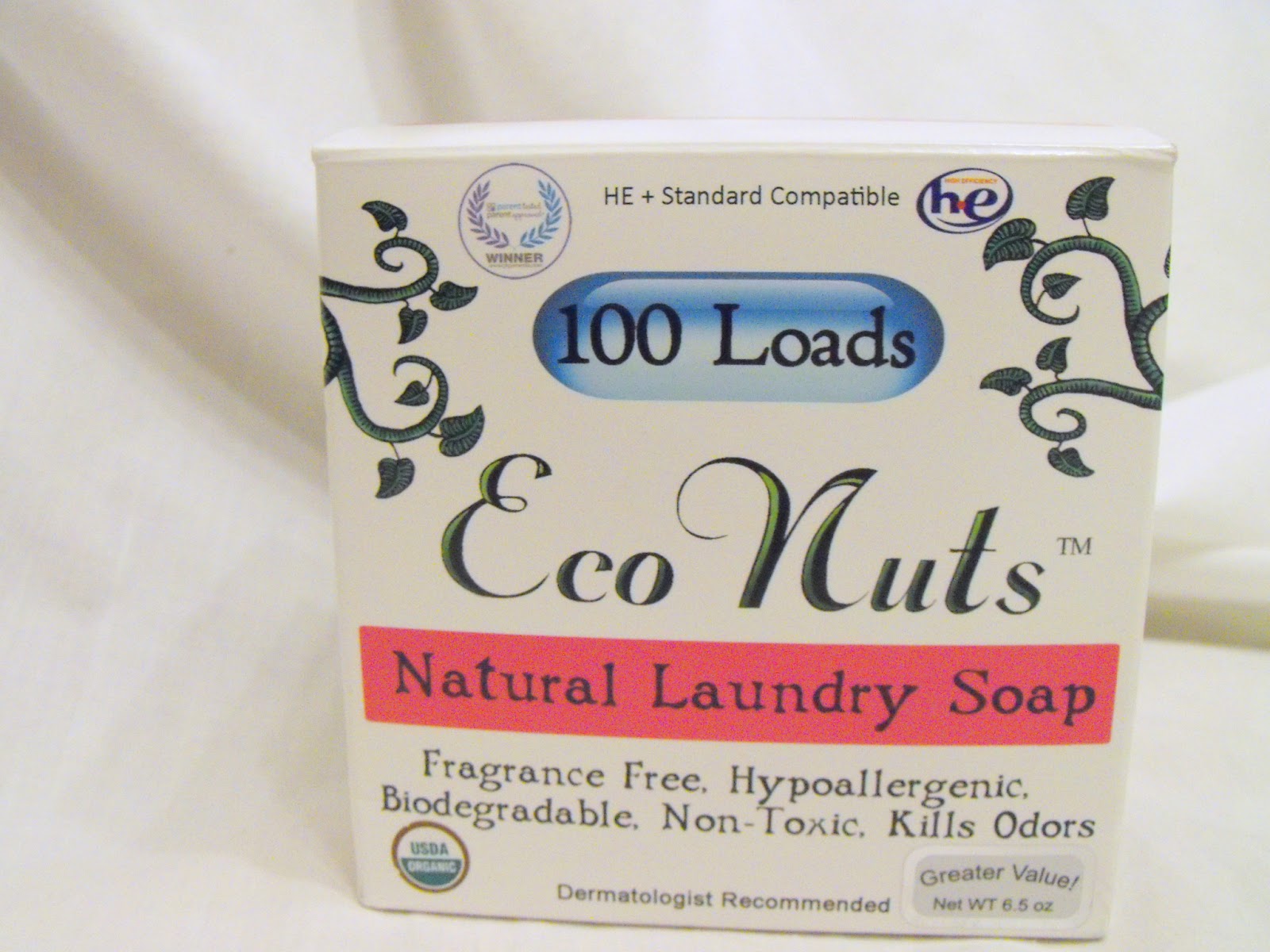
I bought my first batch of soap nuts from Amazon.  I had a $5 credit that was burning a hole in my pocket, so I purchased the 100 load box of Eco-Nuts.  It's a relatively small box packed full of these shiny, brownish-tan dried berries, along with 2 muslin sacks in which to place the berries. 
 
I just tried my first load of laundry, and I must say that I'm impressed!  The clothes came out clean, soft, and scent free straight out of the washing machine.  I did add a Gain fabric softener sheet to the dryer.  This is not necessary, as the saponin in the berries acts as a natural fabric softener; however, I have guys in my household, and let's just say that sometimes you NEED scented laundry. 

The berries work best in hot water or warm water but will also work in cold water, although there may not be as much saponin released.  So if you want to do a load of laundry in cold water but want to make sure there's enough saponin to ensure a clean load, try soaking or steeping the bag of berries in a cup of hot water for about 10 minutes prior to starting the wash load.  Then add the entire batch of water plus the bag containing the berries to the wash and proceed as usual.  

Overall, I thought they worked very well for a first- time use, and I am curious to see how well they work using them numerous times.  Regardless, this is a very economical and eco-friendly way to do laundry! 

Thursday, January 24, 2013

Beer Bread - Broke Food

Beer bread is an excellent quick bread that has just a few ingredients.  Bake it, allow it to cool, and it is great to have with sandwiches or make an egg batter and turn it into French toast.  We like this as just a bread to snack on with real butter and honey.  It also is a great budget stretcher if you're coming up on the end of the week and need bread to go with meals or make sandwiches. 

The recipe calls for Bisquick, but you can also use a substitute for that, which I will list below.  There are only 3 ingredients (my favorite kind!), and it's easy to whip up a batch and have it ready for your next meal.  

Beer Bread 
4 cups Bisquick (this equals one 20 oz. box)*
4 teaspoons sugar 
1 12 oz. can of beer

*If you do not have Bisquick, use 4 cups all-purpose flour, 1 Tablespoon baking powder, 1 teaspoon salt.  

Mix ingredients in a  mixing bowl until it forms a sticky batter. 
Pour into a loaf pan and allow to set for approximately 30 minutes.  This may or may not rise.  Your mileage may vary.  
Bake at 375 degrees for approximately 30-40 minutes or until loaf has risen and turned a golden brown.   
Allow to cool for approximately 10-15 minutes, then remove from pan and allow to cool completely before slicing. 

Tuesday, January 22, 2013

Easy Broccoli Cheese Soup

I love broccoli cheese soup.  It's warm, it's comforting, it's tasty, and it makes a great lunch.  I have seen so many recipes that call for an elaborate cooking process for making this yummy soup.  Upon examining the ingredients, I discovered that it was a cream soup base with broccoli, cheese, and other spices added in.  It didn't take me long to figure out there was an easier way!  So here it is.  My "recipe" for easy broccoli cheese soup. 

And it has only two pre-packaged ingredients! Actually three if you include the milk. 

Here's how it you make it. You use the two items shown above. Yes, that's really it!  It's so easy, and it tastes wonderful. 

EASY BROCCOLI CHEESE SOUP
1 box frozen broccoli and cheese sauce (10 oz.)
1 can cream of chicken soup (10 oz.) 
1 can milk 
Milk to thin to desired consistency 

Microwave broccoli and cheese sauce as directed on package.  While that is cooking, in a medium saucepan over low heat, begin preparing cream of chicken soup.  I recommend using milk because water will make the cheese and cream separate.  Whisk soup in sauce pan until thoroughly mixed.  Once broccoli and cheese are finished cooking, open the plastic package and add broccoli and cheese sauce to soup.  Stir thoroughly to combine.  Thin with more milk to desired consistency.  Serve with bacon bits, fresh ground pepper, salt, and crusty bread. 

If you would like to make this a little more homemade tasting, prior to making soup, you can sautee about 1 tablespoon minced onion in butter.  Then add soup and prepare as usual. 

That is it.  The easiest broccoli-cheese soup you will ever make!


Thursday, January 17, 2013

Tuna Croquettes - Broke Food

While tuna croquettes are listed as today's broke food, they are secretly one of my favorite things to eat.  Most people know salmon croquettes, but if you're really trying to save, croquettes made with tuna are just the ticket.  

I learned this recipe from my late mother-in-law, Judy, and it's been a favorite of ours ever since.  Most people have tuna in their cupboards, and oftentimes if you match coupons with sales, you can get tuna for a great price.  It keeps well, and it's versatile.  

These also make great mock filet-o-fish sandwiches.  Save a patty, and the next day heat in the microwave and serve with lettuce and tartar sauce as a sandwich. 

The recipe below is for 1-2 people.  If you need to feed more people, double or triple the recipe to suit your needs.  Now, on with the recipe! 

Tuna Croquettes (Makes 2-3)
One 2.6 oz. pouch of tuna (or an equivalent size can), drained 
1/2 cup crushed saltine crackers or bread crumbs
1 egg, beaten 
1-2 tablespoons finely minced onion or 1-2 teaspoons dried minced onion 
Salt and pepper

Combine all ingredients.  Allow to rest for about 10 minutes so the crumbs soften a bit.  Form into patties and fry in oil over medium-high heat.  Serve with tartar sauce or cocktail sauce (recipes below). This will make 2 large patties, 3 medium patties, or 4 very small patties.

Homemade Tartar Sauce
1/4 cup mayonnaise 
1 tablespoon sweet or dill relish
Dash onion powder 
Salt and pepper to taste 

Combine all ingredients and serve with fish.  My very first job was in a local fish house restaurant, and this was how they made their tartar sauce and their cocktail sauce.

Homemade Cocktail Sauce
1 cup ketchup
1/2 to 1 teaspoon Worcestershire sauce (to taste)
dash of garlic powder 
dash of Tabasco hot sauce

Mix all ingredients and chill before serving. 


Tuesday, January 15, 2013

Asian Chicken Ramen - Creative Cooking

This is one of those recipes that is relatively inexpensive and makes a TON of food.  It's great to feed a lot of people, and the ingredients are flexible enough that you can make more of less of it  depending on your resources.  
We used to live in Colorado, and on more than one occasion, we would have a house full of people.  When that happened, I had certain go-to recipes that I knew would be tasty, filling, make large quantities, and were usually something that everyone would like.  Add a salad and drinks, and this is enough to feed a crowd. 

 Asian Chicken
4 pkgs. Ramen noodles
4 C. water
¼ C. soy sauce
1 tsp. crushed red pepper flakes (may omit)
2 (16 oz.) pkgs. mixed vegetables, preferrably Asian stirfry, but any will do
6 cups cooked chicken of your choice (can reduce to as little as 2 cups, if desired; 6 cups is a lot of chicken)

In very large pot bring 4 cups water to boil. Stir in seasoning packets from Ramen noodles, soy sauce, and pepper flakes. Add noodles. Cover and cook for 2 minutes. Do not drain noodles. Add veggies. Cover; cook until noodles and veggies are tender, 3-4 minutes. Stir in chicken. Makes almost 2 gallons.

HINT: To decrease the cost of this dish, you can decrease the chicken and add 2-3 scrambled, chopped up eggs.

Saturday, January 12, 2013

Homemade Disinfecting Sprays Like Lysol

It's that time of year again.  Time for colds, flu, and just general crud.  Everybody is cooped up, and it's easy to spread germs and viruses.  All three of us have been sick.  I started it, and the hubster and my son now have it.  We've tried hard to wash hands, keep everything swabbed with disinfecting wipes and sprays, but somehow we still managed to pick up a bug.  

The most important thing to remember is that good old soap and water do the best job of removing germs.  The surfaces are clean, and any remaining germs or viruses can be killed with disinfectants and other sanitizing agents.  While I love disinfecting wipes, they can't get everywhere.  That's when disinfecting sprays come in handy.  They form a fine mist that gets into nooks and crannies and can be sprayed so that there is even coverage.

Most disinfecting sprays do their best job when they are allowed to sit for a few minutes.  The optimal time is 5 minutes in order to kill everything.  Unfortunately, some of those sprays are not only expensive, they stink!  No matter how they are fragranced, it seems they still smell like chemicals. Blech! 

You can make your won disinfecting sprays at home and make them suited to your liking.  There are two recipes listed below.  One is an alcohol-based disinfecting spray.  The other is a paracetic acid spray.  The alcohol-based one is easier to make, is very effective at killing the flu virus, and is reasonably safe for all surfaces.  The paracetic acid mixture is acidic and contains peroxide so is not recommended for use on items that will bleach, such as fabrics. The CDC has deemed alcohol, peroxide, iodine-based products, and detergents as suitable substances for killing the influenza virus (link HERE). 

Finally, if you can stand the smell, a simple mixture of 1 tablespoon of bleach to 1 quart water or 1/4 cup bleach to 1 gallon of water is an effective germ and virus killer.  However, it is not safe for all surfaces, and... it stinks.  

Here are some alternative recipes for homemade disinfecting spray.  

Alcohol-Based Disinfecting Spray:
1 spray bottle 
isopropyl (rubbing) alcohol 70% (the regular stuff you buy in the store)
essential oils such as tea tree oil, lavender oil, rosemary oil, or peppermint oil 
OR
1 teaspoon Lysol cleaner or other disinfecting liquid cleaner

In spray bottle put either 15-20 drops of essential oil or 1 teaspoon of disinfecting cleaner.  Fill with alcohol and insert sprayer.  Shake gently to combine.  Spray on surfaces and allow to sit until dry.  

Paracetic Acid Based Disinfecting Spray:  
1 spray bottle
1/4 cup 5% white vinegar
1/4 cup 3% peroxide 
5 drops essential oil 
(Do not use cleaner with this solution.) 

Mix ingredients and carefully pour into a spray bottle and set sprayer to fine mist.  Spritz on hard surfaces that are not easily bleached or prone to damage from liquids.  Allow to sit until dry.  

Note:  This makes a small quantity.  If you need larger amounts, adjust ingredients accordingly by using 1 part vinegar to 1 part peroxide. 


For tips on preventing flu see this post from the CDC:  http://www.cdc.gov/flu/protect/stopgerms.htm


Thursday, January 10, 2013

Unusual Uses for Common Household Things


We all have little tips and tricks that we use.  I love finding unusual uses for items beyond their normal use.  Some of these may be obvious, some may be new, but they are fun and interesting.  

What little item do you use that is out of the ordinary?  I'd love to know what those are.  Here are some of mine: 


1.    Nail polish remover to take labels off plastic containers.  Saturate a paper towel with nail polish remover.  Wrap it around the item that needs the label or printing removed.  Allow to sit.  Periodically redampen the paper towel, then wipe off the label!  May also use furniture-grade acetone, for this, as well, but be sure to wear gloves. 

2.    Use an antiscratch scrubber kitchen sponge (the kind with a loofa on one side and sponge on the other) in the shower to remove calluses from feet.  If it gets icky, either put it on the top shelf of the dishwasher and run through with a load or put it in a zippered bag and wash it with a load of towels to get clean. 

3.    Aspirin, salt, and water paste for canker sore cure.  This is an old trick that my dentist gave to me long ago to treat canker sores.  Crush an adult aspirin into a powder.  Add an equal amount of salt.  Add enough water to make a paste.  Using a dampened Q-tip, dab a little on the canker sore.  This will burn like crazy, but it “cauterizes” the sore, and it will oftentimes be gone the next day.   (See medical disclaimer below.) 

4.    Make a paste of cooking oil and baking soda as a homemade “Goo Gone” to remove stains and other greasy residue. 

5.    Use white vinegar in your dishwasher’s rinse dispenser in stead of expensive commercial rinse products to stop hard water and soap spots.

6.    A crumpled piece of aluminum foil makes an excellent scrubber if no steel wool pads are available. 

7.    A muffin tin with each compartment filled halfway makes an excellent extra ice tray.  Fill with fruit punch, juice, tea, or Kool-aid for ice that won’t dilute in your drink. 

8.    Use Rain-X meant  to use for windshields on shower doors.  Water spots won’t form, and the shower glass will be easier to clean.

9.    Use car wax to wax sinks and showers.  Clean shower stalls and sinks, then apply a coat of car wax and buff.  This will leave a shiny surface, and soap scum won’t stick to it.

10. Use a sheet of Contact paper with the backing removed for furniture, clothes and car seats to make dog hair and lint pickup an extra quick task. 

11. Want extra long eyelashes?  Clean an old mascara wand, and use it to apply either mineral oil, baby oil, or Vaseline to your eyelashes each night.  This will condition them and help them grow. 

12. Aluminum foil makes a great connector/contact point  if a spring breaks inside a battery compartment of a piece of electronics or a toy. 

13. Mix coffee grounds (used or fresh) and olive oil and use for a facial or body scrub.  The grounds provide an exfoliating effect, the caffeine will help tighten skin and improve circulation, and the olive oil provides moisture.  Rinse well after use.

14. Spray Static Guard on your hair brush to relieve static in your hair or use a fabric softener sheet gently rubbed over your hair to help detangle it.

15. Got stuck-on, burned-on food in a pan or casserole dish?  Place a fabric softener sheet in it, then fill the pot or dish with hot water, and allow to sit overnight.  The gunk will wash off!

16. Got an old T-shirt that is a little on the snug side?  Use it to dry your hair!  Pull just the neck over your head, with the shirt going in the wrong direction, then use the remaining T-shirt to wrap up your hair.  This will dry your hair quickly, hold your hair up while you apply makeup, and is even more gentle than a bath towel. 


Medical disclaimer:  Material on this Website is provided for informational purposes only. It is not a substitute for medical care, consultation, or advice.

Friday, January 4, 2013

Pasta with Grilled Chicken, Tomatoes, and Black Olives - Creative Cooking

I've been craving carbs like crazy. Sometimes a girl just wants her pasta.  We also had leftover grilled chicken.  What better way to get my carb fix than to whip up a tomatoey sauce for spaghetti along with the grilled chicken?  I can't think of much better than that! 

If we're having a busy week or, as in this week I've been sick, the hubster sometimes buys a giant pack of boneless, skinless chicken breasts and grills all of them at once so that we can store them in the fridge.  We warm them up, slice them up into sandwiches, or, as in this case, add them to other dishes.  I love combining them with other ingredients to make stir fry or toppings for pasta.  

These were ingredients I had in my pantry.  I made this because I wanted a sauce that was on the lighter side.  I also wasn't in the mood for a creamy sauce, so this is what I made.  It came out very well!

PASTA WITH CHICKEN, TOMATOES, AND BLACK OLIVES
1-2 grilled boneless, skinless chicken breasts, sliced
1 tablespoon cooking oil such as olive oil
1 clove garlic, minced 
1 medium onion, chopped 
1 teaspoon oregano
1/2 teaspoon basil 
1/2 teaspoon red pepper flakes
1 can (14 oz?) Italian flavored diced tomatoes, drained (usually says flavored with basil, oregano, and onion)
sliced black olives
parmesan cheese to taste

 4-6 servings of spaghetti or other pasta, cooked

Place oil in large skillet and heat.  Add garlic, oregano, basil, and red pepper flakes.  Stir for a few seconds to heat and saturate spices.  Add chicken breast and onion. Stir to coat, and allow chicken to heat through, 1-2 minutes.  Add tomatoes, stir, then allow any liquid from the tomatoes to reduce down.  Serve over spaghetti, top with black olives, and sprinkle with Parmesan cheese.  Salt and pepper to taste.  Serve with crusty bread and salad.

Thursday, January 3, 2013

Creamy Potato Soup - Broke Food

I love a hot bowl of potato soup, especially considering how cold it's been lately.  Also, for me, this is comfort food.  When I was a kid and didn't feel well, my mom would make me a bowl of "tater soup."  It was a very soothing soup, especially if you have a stuffy nose or have the flu, and it's extremely easy to make in under an hour. 

As my recipes are prone to be, this is a simple one that can be gussied up or left plain in order to suit your taste, budget, and what you have in your pantry.  Also, as I'm prone to do, I don't follow any "rules" with regard to what is or isn't the right kind of potato to use.  I use what I have and make it work for what I need.  The soup pictured reflects that.  I used Yukon Gold for the soup photographed above.  Some might recommend a red potato or say not to use a white potato.  I believe in your food working for you, not having to go out and buy a bunch of fancy stuff in order to make a meal.  If the type of potato is a hard or very firm potato, slice it thinner and then cook longer, checking consistency of the potatoes while boiling until they're the right consistency.  After all, we're broke!  That's why we're making this soup!

The basic ingredients needed are potatoes, onions in some form (fresh or dried both work), some form of milk product, water, and salt and pepper.  The rest can be added to your taste, based on what you have.  I'm going to list the basic recipe, and then below I will list variations/additions that you may want to try.   The variation shown in the photo above includes:  Potatoes, onions, celery, chopped ham, evaporated milk, and butter. 

Creamy Potato Soup Basic Recipe
3-4 medium to large potatoes peeled and cut into small chunks (or one potato per person)
1 medium onion, minced (or equivalent dried minced onion)
Water to cover
2/3 to 3/4 cup milk, cream, half-and-half, canned evaporated milk, or powdered milk
Salt and Pepper to taste 
3-4 tablespoons butter or Margarine

In a large saucepan, place potatoes and onions.  Add just enough water to cover.  Place lid on sauce pan and bring to a rolling boil.  Reduce heat and simmer until potatoes are soft. Scoop out about 1/2 cup of cooked, drained potatoes.  Mash these thoroughly, then return to the pot and stir in order to thicken the soup.  Turn fire back on under mixture and add milk and butter or margarine.  Heat until steaming, then add salt and pepper to taste. 

Note, if you use powdered milk you may want to only reconstitute it with half the water necessary in order to help the soup's consistency not be too thin. 

Variations/Additions
Meat:  Add any cooked meat that you may have such as leftover ham, cooked and crumbled bacon, grilled chicken, chopped turkey, cooked Spam, cooked hamburger meat, kielbasa, and even finely chopped leftover deli meat. 
Vegetables:  Celery, green onions, carrots, corn, chopped sauteed bell peppers, broccoli, cauliflower, or whatever is left in the fridge from prior meals. 
Broth:  If available, you may substitute chicken or vegetable broth for some of the water in this recipe.  
Cheese/Sour Cream:   If desired and available, you can either top the soup with cheese or stir in up to 1/2 cup finely shredded cheese of any type (stir well and do not boil if this is added) or sour cream to add richness and protein to the soup.  
Spices:  You may also add garlic, a small bit of red pepper flakes, rosemary, basil, marjoram, tarragon, or other spices (not all at once; choose wisely).

This is a taste-as-you-go recipe.  Start with the basic recipe, then add ingredients to your liking.  If you have doubts about how an ingredient will taste in the soup, remove a small amount of soup to a cup or bowl, add the ingredient, taste, and see how things are shaping up.  Once you get the recipe to your liking, write down your additions for use the next time.  

Serve with crusty bread, a salad, crackers, or Fry Bread.  This makes a very filling meal.  It keeps well and reheats well, so it's great to take in a lunch the next day or warm up for a quick meal. 


Monday, December 31, 2012

Recycle Used Wax Melts/Tarts into a Candle

If you've joined the craze for the wax warmers such as Scentsy or Pink Zebra or even the ones they have at Walmart, you have probably found scents you love.  However, after the wax scent dissipates, you want to change out the wax, but it seems a waste to just toss it out. 

This is an easy way to reuse the wax, and, believe it or not, the scent is still very much there once it burns.  The great thing about making these candles is that you get a slightly different scent as each layer burns through, and oftentimes it makes interesting scent combinations in the process.

I have different jars started for different scents.  I have one jar that is for the woodsy/spicy/kitchen scents such as Mountain Lodge, pumpkin pie, cinnamon spice, etc., and another that is for flowery/citrusy scents such as lavender, fresh cut grass, lemon, etc.  You can make as many or as few as you want, or even just have one jar into which everything gets dumped.  Whatever you choose, it's a great way to reuse the wax!

To make these you will need:
1 empty jar that is relatively heat safe (a Mason jar is perfect)
1 premade wick with base (I got mine at Hobby Lobby $2.99 for 5 click HERE to see)
Some type of adhesive, such as E6000, Super Glue, etc.
Melted wax
Pen, pencil, or dowel to hold the wick in place and steady while the jar is being filled.

Clean the jar and make sure it is dried.  Put a dab of adhesive on the bottom of the metal premade wick and poke it down into the jar, centering it, and then use a long object to press it to the bottom of the jar to make sure it's adhered.  

Once the wick has set, take the dowel, pencil, or pen, and wind the wick around it a couple of times until the dowel sits flush on top of the jar.  This will hold the wick centered until the jar is filled.  Next, begin pouring the melted wax.  

It's not necessary to do this all at once.  You can stick the jar in an out of the way spot and add to it whenever you change out wax in your warmer or if you've come to the end of a candle and need to pour off the remaining melted wax.  Add to this layer by layer.  

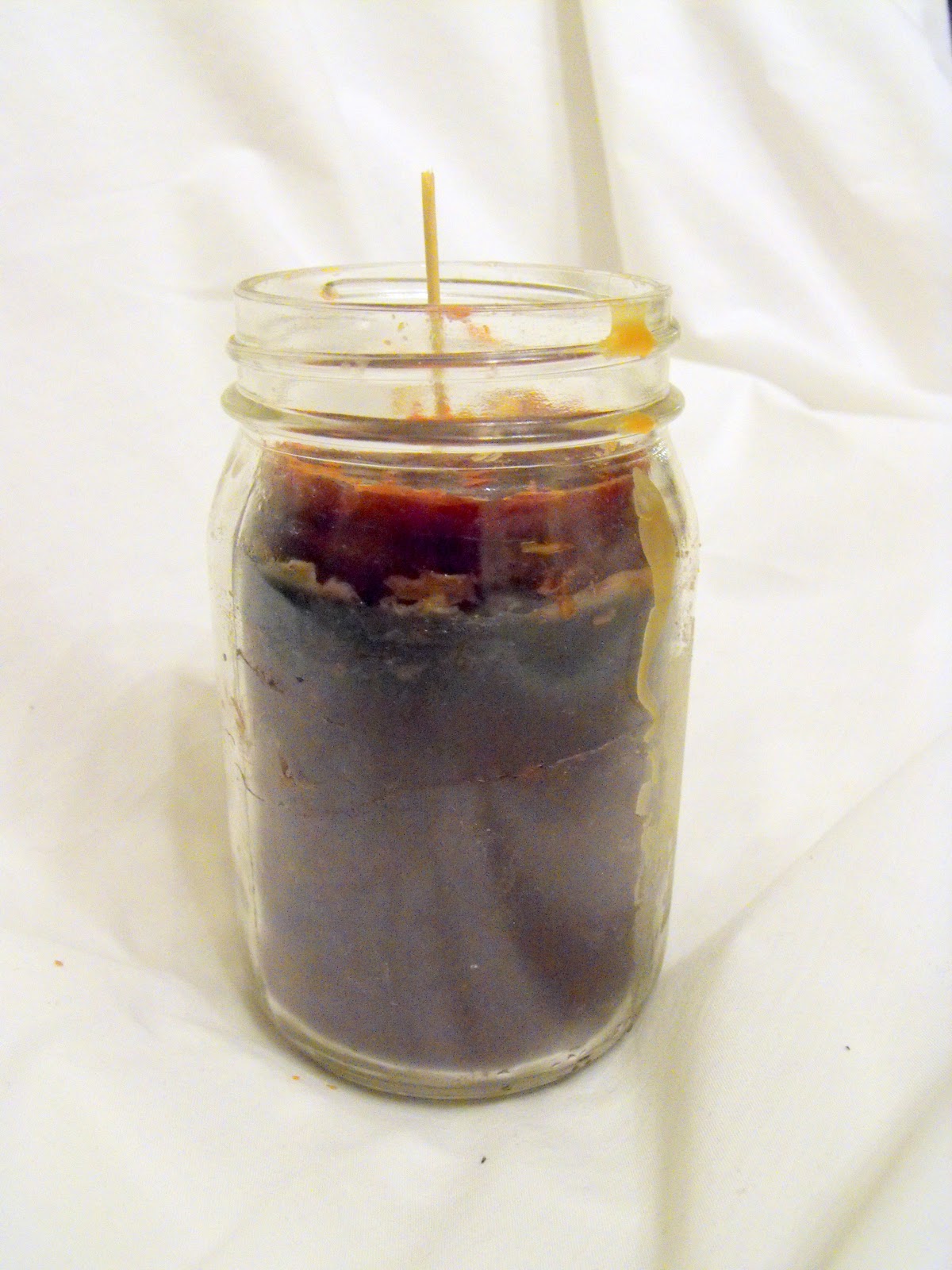
When the wax is to approximately the bottom of the threads on the jar, cut the wick off and trim to approximately 1/2 inch in length.  Now it's ready to use! (The photo below is of another candle made this way with darker wax.)


Sunday, December 30, 2012

Top 10 Posts of 2012


It's that time!  Time to reflect on the past year.  Since I just started this blog a little over 3 months ago, I don't have a whole lot of posts, but there have been over 100 of them.  I thought I'd do a recap of the most popular ones.  Click on the title of each numbered post to see the original. 

Four recipes that were made to go straight from the freezer into either the crock pot or to place directly on the grill.  Recipes included Mango Chipotle Chicken, Smothered Pork Chops, Beef Tips, and Pepper Steak. 

Directions on how to use Sharpie markers and plain white mugs or dishes from the dollar store to make gifts.  Decorate and bake at 350 degrees for 30 minutes. 

This was a guest post written by my friend, Kasie Robinson, who is a fellow transcriptionist and jewelry maker.  Check out her awesome story and recipe, and then cruise on over to her Artfire shop HERE for some darling earrings.  

Make a tasty, exotic-tasting meal with simple ingredients from your cupboards.  This recipe features that ever-popular food Ramen noodles but is dressed up in a way that is satisfying to both your taste buds and your pocketbook. 

A list of hints and helps for turning your own recipes into freezer-to-crock pot meals.  

Tips, tricks, and thoughts about saving on groceries that do not normally go on sale or have coupons readily available. 

Want to cook all your food at once but don't want the flavors to mix?  Foil packets for the crock pot may be the answer.  Just wrap up your items, seal in foil, and place in the crock pot!

Use a dollar store glass pebble, wire, and some pliers to make a beautiful, unique, and simple gift. 

This is a recipe for the crock pot that is basically chicken chili but uses chili ingredients rather than the usual white sauce that's associated with chicken dishes. 

This is a tutorial for how to make a glue-on bail that turns almost any object into a pendant for a necklace.  Simple, easy, and very pretty! 

There they are!  The most popular posts for 2012.  Thank you to all my readers who have made this adventure so much fun.  I look forward to seeing what 2013 has to bring!