Search

Powered by Blogger.

Networked Blogs

Showing posts with label green. Show all posts

Monday, July 29, 2013

Homemade Orange Enzyme Cleaner


I had a duh moment, and it involves this orange enzymatic cleaner that's been circulating on Pinterest.  Every once in a while I see an idea, but I drag my feet because the effort doesn't seem like it is worth it.  We finally had a whole bunch of oranges which, of course, generate orange peels, and I decided to give making my own homemade orange enzymatic cleaner a shot.  Reusing something and it's natural. Two bonus points! 

Most of the recipes I had seen were fairly complicated.  Most involved using white vinegar, and some went so far as to add yeast and sugar to this mixture.    I decided to take a different route, using clear ammonia instead, and I was thrilled with the results. 

This stuff cuts grease like nothing I have ever seen.  It's especially great for things like stove tops, vent hoods, and I have also been using as an additive it in my mop bucket to mop my floors.  I thought my floors were clean until I started using this!  You can literally see the dirt start to rise up and separate before you wipe or mop it away.  My mom is so in love with it, that I started her a batch, and she has shared the recipe and great results with others.  Here is my version of this awesome cleaning solution: 

Homemade Orange Enzyme Cleaner

Takes 2 weeks to make but worth it!

1 empty jar, the larger the better (I use a 1 quart canning jar)
Orange peels enough to fill the jar at least halfway
Clear ammonia

Place orange peels in jar and cover to rim of jar with clear ammonia.  Cap jar and allow to sit in a warm, dark area for 2 weeks.  Then, strain orange peels out and put remaining liquid back in jar.  (The orange peels will be a gelatinous consistency, and the liquid will be the consistency of syrup.  Throw orange peels away.)

To make cleaner:

Use ¼ to ½ cup orange liquid
1 generous squirt of dish soap
Water to fill squirt bottle

To mop floors, in mop bucket use:

Use ½ cup to ¾ cup orange liquid
Generous squirt of dish soap
Fill with water

Mop as usual.  No need to rinse. 

The orange cleaner is *excellent* at cutting grease, especially on stove tops!  Plus, it’s a great way to be “green” when you clean. 

Tuesday, January 29, 2013

Soap Nuts for Laundry

I am always searching for new ways of doing things, less expensive things, things that are also ecologically friendly, and things that are just awesome.  Soap nuts are delightful natural cleaning product that is excellent for use in the laundry or for making all-natural cleaning products! Ever since I saw mention of them on an internet forum which I visit, I've been curious, so I did some research and decided to give them a try. 

Soap nuts are berries, or technically a drupe, from the Sapindus tree or shrub (Sapindus Mokorossi).  They grow naturally in the Himalayas and produce saponin.  That is a natural surfactant that changes the surface tension of water and allows the water to get into the fibers of clothing, break down dirt, and float it away.  If you use soap nuts in your laundry, there are no suds.  Instead, the dirt breaks down, the water looks dirty, but the clothes are clean.  The dirt simply goes down the drain with the rest of the waste water.  There is no smell/scent, and soap nuts are very gentle, so they're perfect for baby clothes, diapers, or for those who have sensitivities to soaps, detergents, or fragrances. They are "green," eco-friendly, and are safe for septic and sewage systems. 

The best part is that you can get multiple uses from just a few of the berries.  They can be reused up to 10 times before they disintegrate and need to be replaced.   Just remove the berries from the load of laundry once it's finished, leave them in their bag, allow them to dry, and reuse with your next load.  When the berries become very thin and crumble, it's time to replace them.

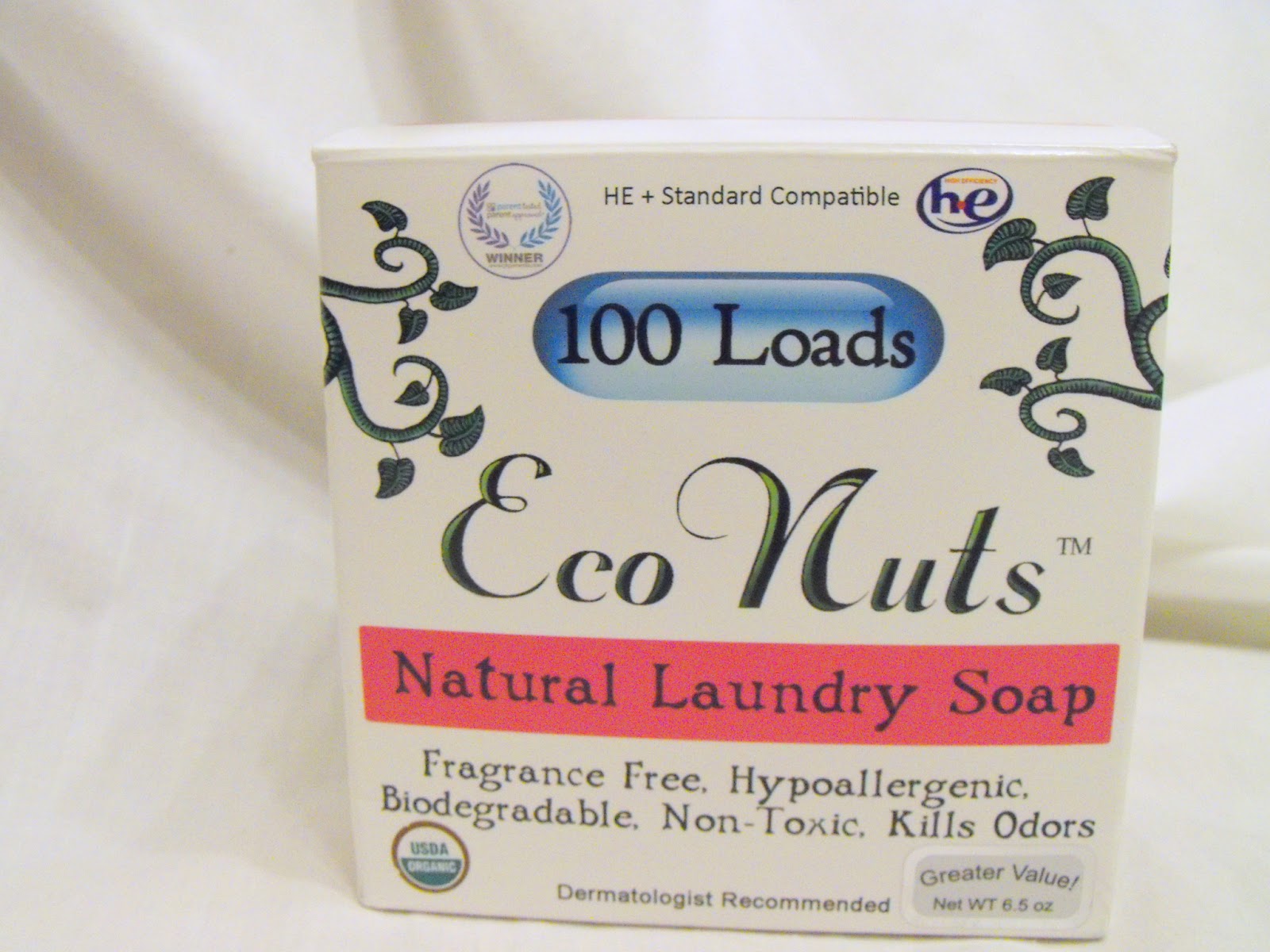
I bought my first batch of soap nuts from Amazon.  I had a $5 credit that was burning a hole in my pocket, so I purchased the 100 load box of Eco-Nuts.  It's a relatively small box packed full of these shiny, brownish-tan dried berries, along with 2 muslin sacks in which to place the berries. 
 
I just tried my first load of laundry, and I must say that I'm impressed!  The clothes came out clean, soft, and scent free straight out of the washing machine.  I did add a Gain fabric softener sheet to the dryer.  This is not necessary, as the saponin in the berries acts as a natural fabric softener; however, I have guys in my household, and let's just say that sometimes you NEED scented laundry. 

The berries work best in hot water or warm water but will also work in cold water, although there may not be as much saponin released.  So if you want to do a load of laundry in cold water but want to make sure there's enough saponin to ensure a clean load, try soaking or steeping the bag of berries in a cup of hot water for about 10 minutes prior to starting the wash load.  Then add the entire batch of water plus the bag containing the berries to the wash and proceed as usual.  

Overall, I thought they worked very well for a first- time use, and I am curious to see how well they work using them numerous times.  Regardless, this is a very economical and eco-friendly way to do laundry! 

Monday, December 31, 2012

Recycle Used Wax Melts/Tarts into a Candle

If you've joined the craze for the wax warmers such as Scentsy or Pink Zebra or even the ones they have at Walmart, you have probably found scents you love.  However, after the wax scent dissipates, you want to change out the wax, but it seems a waste to just toss it out. 

This is an easy way to reuse the wax, and, believe it or not, the scent is still very much there once it burns.  The great thing about making these candles is that you get a slightly different scent as each layer burns through, and oftentimes it makes interesting scent combinations in the process.

I have different jars started for different scents.  I have one jar that is for the woodsy/spicy/kitchen scents such as Mountain Lodge, pumpkin pie, cinnamon spice, etc., and another that is for flowery/citrusy scents such as lavender, fresh cut grass, lemon, etc.  You can make as many or as few as you want, or even just have one jar into which everything gets dumped.  Whatever you choose, it's a great way to reuse the wax!

To make these you will need:
1 empty jar that is relatively heat safe (a Mason jar is perfect)
1 premade wick with base (I got mine at Hobby Lobby $2.99 for 5 click HERE to see)
Some type of adhesive, such as E6000, Super Glue, etc.
Melted wax
Pen, pencil, or dowel to hold the wick in place and steady while the jar is being filled.

Clean the jar and make sure it is dried.  Put a dab of adhesive on the bottom of the metal premade wick and poke it down into the jar, centering it, and then use a long object to press it to the bottom of the jar to make sure it's adhered.  

Once the wick has set, take the dowel, pencil, or pen, and wind the wick around it a couple of times until the dowel sits flush on top of the jar.  This will hold the wick centered until the jar is filled.  Next, begin pouring the melted wax.  

It's not necessary to do this all at once.  You can stick the jar in an out of the way spot and add to it whenever you change out wax in your warmer or if you've come to the end of a candle and need to pour off the remaining melted wax.  Add to this layer by layer.  

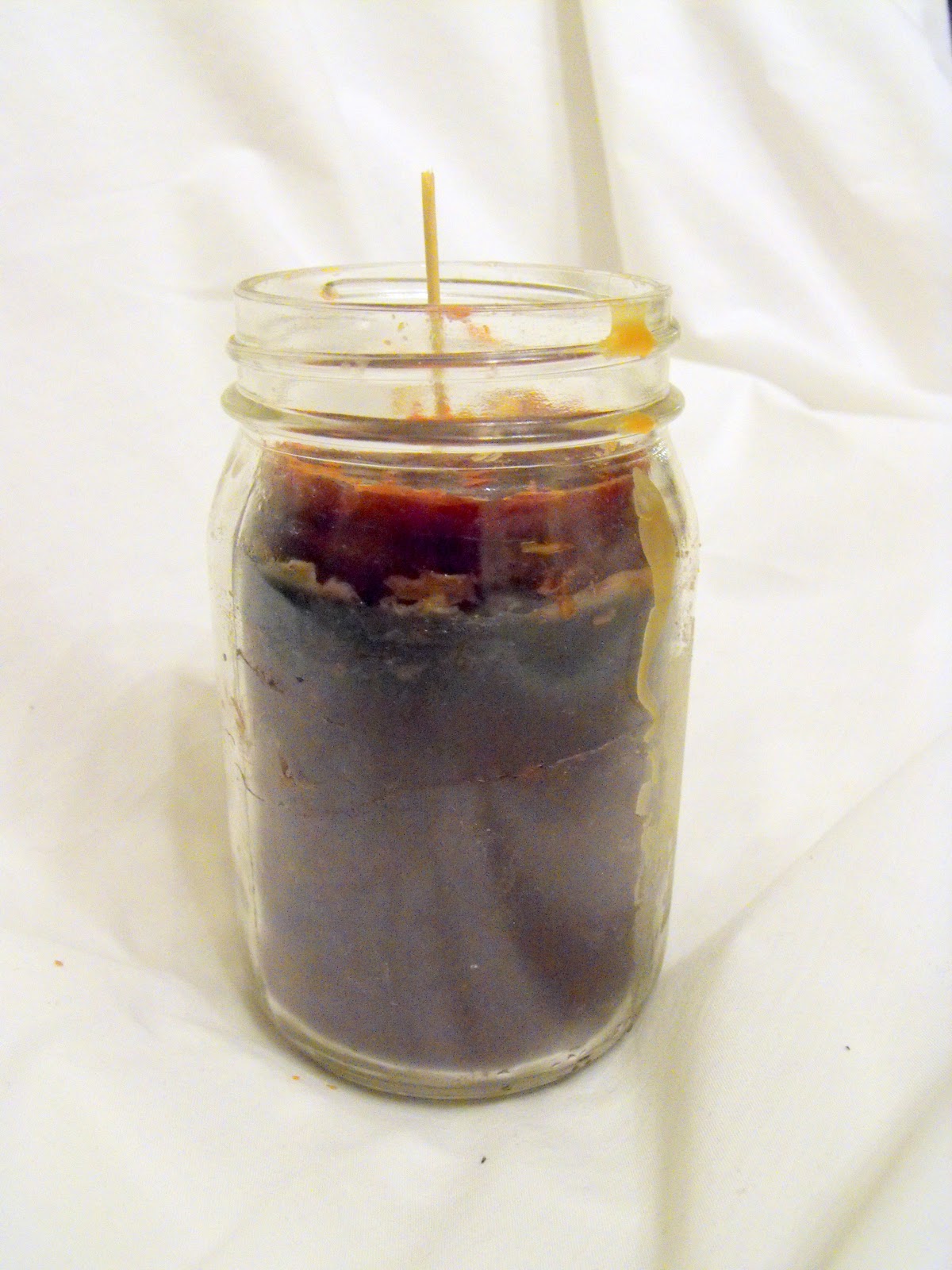
When the wax is to approximately the bottom of the threads on the jar, cut the wick off and trim to approximately 1/2 inch in length.  Now it's ready to use! (The photo below is of another candle made this way with darker wax.)


Saturday, December 29, 2012

Easy Deep Conditioner for Hair

Olive oil is known for its benefits as a food substance because it is flavorful and is known to help lower cholesterol.  It is also terrific as a topical application for skin and hair.  I love making this easy conditioner recipe listed below and using it a couple of times a week for a deep conditioning hair treatment.

Olive oil is biologically closest to sebum, which is the oil naturally produced by our bodies.  Why don't we just leave the natural oils there?  Well, that sounds great, but unfortunately sweat, bacteria, and skin cells tend to collect in the oils present on our body, so it's necessary for us to take a shower or bath, grab our favorite soap, and get squeaky clean.  Unfortunately, soap tends to strip those natural oils and can sometimes leave us with overly dry skin or hair.  That's where conditioners and lotions come in.

This is another beauty tip that was given to me by my brother.  Use this 2-3 times a week (or less, depending on your hair).  Keep it in the shower for easy use, and make sure that you blow dry your hair afterwards to help the conditioner "set."  Otherwise, you may seem to have an oily residue on your hair. 

OLIVE OIL DEEP CONDITIONER:
1 bottle of inexpensive conditioner, your choice
1 teaspoon of olive oil per 8 oz. of conditioner
(Example:  If your bottle is 12 oz., you will need 1-1/2 teaspoons of olive oil.  If it is 16 oz., you will need 2 teaspoons of olive oil, and so on.)

Open the conditioner and squirt out just enough to give you some "shaking room" in the bottle.  Add the olive oil, and shake for 1 minute. Store the conditioner in the shower or wherever you wash your hair.  Apply liberally to freshly shampooed hair and allow to sit for 2-3 minutes.  Try to keep away from scalp.  Rinse well, then blow dry.  Blow drying is a MUST in order for the conditioner to set. 

That's it!  This conditioner will leave your hair silky smooth and well conditioned without spending a ton of money! 

Sunday, December 2, 2012

Oh no, I'm out of dryer sheets!


Have you ever uttered that phrase?  Especially during a marathon laundry session?  White vinegar and an aluminum foil ball are all you need to achieve soft, static-free laundry. 

I use about 1/2 cup of white vinegar in the rinse water for a top-load machine.  Use 1/4 cup for HE machines.  For both machines, place the vinegar in the liquid fabric softener dispenser for your machine.  Your clothes may or may not come out with a vinegary smell to them, but that will disappear in the dryer.  

If your clothes have static, this is where the aluminum foil ball comes in.  Tear off an approximately cookie sheet size piece of foil and roll it into a ball.  I wait until the clothes are dry or nearly dry to see if they are sticking together.  Then I throw in 1-2 balls of foil and restart the machine to finish drying.  I know some people place the foil balls in at the beginning of the drying cycle, but I have a fear of the foil abrading the inside of the machine, so I wait until the clothes are almost dry. The foil balls will last for up to 6 months and can be reused over and over again. 

This is really neat trick for people who have allergies and are allergic to commercial scented fabric softeners.  It leaves no scent whatsoever, except what remains from your laundry detergent, and it has an added benefit of making any towels you may have washed super soft, fluffy, and more absorbent.  The white vinegar removes hard water deposits and soap residue from prior washings, making clothes brighter and softer.  

This method is also environmentally friendly and "green" because it does not use harsh chemicals, dyes, or fragrances to achieve soft and static-free clothes.  I use this frequently with my loads of white towels and wash clothes to make them soft and more absorbent.  While I like the smell of fabric softeners and use them most of the time, this is a wonderful and economical alternative to store-bought softeners.

Tuesday, November 13, 2012

Freezer to Crock Pot - Pork Green Chili


We love spicy food.  This recipe for pork green chili fits the bill.  It is not a heavy chili but is very flavorful and uses broth and other spices to create interesting and satisfying flavors.  

This works well in the crock pot  and can be cooked straight from the freezer.  It also works equally well when made stove top.  Serve it with tortillas or spoon it over rice.  Top with a dollop of sour cream, and you'll be in heaven. 

Pork Green Chili

2 Tablespoons olive oil or cooking oil
3 lbs. pork, cut into medallions (I used pork tenderloins)
Ground black pepper
1 large onion, chopped
2 minced garlic cloves
2 green (bell) peppers, chopped
2  (4 oz.) cans green chiles, chopped
1 teaspoon oregano
½ teaspoon ground cumin
¾ teaspoon salt
2 Tablespoons dried cilantro (If using fresh cilantro, increase to ½ cup).
1 teaspoon vinegar
1 cup chicken broth (or 1 cup water and 1 chicken bouillon cube)

Lightly brown meat in oil over medium heat.  Lightly pepper meat and place in the bottom of a 1 gallon zippered freezer bag.  Add remaining ingredients.  Squeeze air out, seal, and massage ingredients to distribute. 

When ready to cook, place in crock pot and cook on high for 6 hours or low for approximately 8 hours.  Serve with rice, tortillas, and sour cream. 

Stovetop version:  Lightly brown meat in oil over medium heat.  Add onion, garlic, and peppers and saute until onions are translucent.  Add remaining ingredients.  Bring to a boil, cover, and simmer 1-1/2 hours. Stir periodically and check liquid level.  Add water as needed.  

Sunday, November 4, 2012

Scouring Powder Alternative


We all know there are things that just need a good scrubbing or scouring sometimes.  This is an alternative to the harsh scouring powders that contain bleach (Comet, Ajax, etc.).  It's simply blue Dawn dish soap and baking soda.  Honestly, there aren't too many things that I haven't used Dawn and baking soda to clean.  There will be more of those in later posts, but for now, we'll start with this.  

In order to make your own scouring alternative, using a damp sponge or soft cloth.  Squirt a little Dawn on the sponge or cloth, then sprinkle with baking soda and scrub the surface.  Scrub as you would with a scouring powder, then rinse thoroughly with water.

This works great for things like the bath tub, shower tiles, kitchen sink, counter tops, and I have even used it as cleaner to get bug splats off the front of my car without scratching the paint.  I have been told that it is also acceptable for cleaning flat-topped stoves, though I have not tried it myself, so use at your own risk. 

While it will not necessarily bleach stains, it will remove any substances that are stuck on and does a great job of dissolving oils and soap scum left behind in showers. I like to use it on my stovetop to get the tough, baked-on spills left after cooking.  

It leaves a fresh, clean scent.  It is nontoxic.  It's "green."  It won't hurt septic systems.  It's readily available whenever you need it, and it's economical.  It also cleans great, and is nowhere near as expensive as other scouring powders!