Search

Powered by Blogger.

Networked Blogs

Showing posts with label cleaning. Show all posts

Friday, August 16, 2013

Shelf Life of Household Chemicals


Ever wonder why your favorite cleaning or household product just didn't seem to do the trick any more? Have you added bleach to your laundry whites only for them to come out as grungy as they were when they went in?  Get a great deal on dish soap, stock up, and then discover that your dishes aren't getting clean?  Your household cleaners might be past their shelf life.

Some items will store indefinitely, but other items lose their effectiveness after a period of time.  Some of those times are surprisingly short. I began looking into shelf life/storage possibilities when I started avidly couponing and stockpiling.  There are some things that I discovered might expire before it could be used, so I keep this information in mind when making my purchases. 

Household bleach is an excellent example of this.  It has a relatively short shelf life of around 3-6 months.  That may seem like a long time, but that is from date of manufacture.  Bleach also looses its umph when exposed to heat.  So if the bleach was bottled, put onto a semi truck, trucked across the country, then stored in a stockroom of a retail store, it will probably need to be used fairly quickly.  The bleach will not look or smell any different; however, if you have used bleach and it just doesn't seem to be doing its job any more, it may very well be outdated.  

Keep in mind that it's not as if a bomb goes off inside a bottle or package of an item that it automatically becomes ineffective on a certain date; however, it is a guideline of which to be aware so that you will know whether a product is going to be effective or if it might need to be tossed and purchase something new. 

Here is a list of other household items and their shelf lives: 

Acetone (in nail polish remover):  Unopened 1 year; opened 6 months. 

Ammonia, household:   Indefinite.  Will evaporate if left uncapped. 

Baking Powder :  Indefinitely unopened; 9-12 months opened (Check by adding 1/4 teaspoon to 1/2 cup very hot water.  If it does not begin fizzing, it's out of date and will no longer work.) 

Baking Soda:  Indefinitely unopened; 3-4 years opened however slowly loses its umph the longer it is exposed to air.  (Check by adding 1/4 teaspoon plus 1/4 teaspoon vinegar to 1/2 cup very hot water.  If it does not begin fizzing, it's out of date and will no longer work.) 

Bath Soap, bar:  18 months to 3 years. 

Bath Soap, liquid:  1 year; antibacterial soap loses its effectiveness in about 9 months.

Borax (laundry):  Indefinitely, according to the 20 Muleteam Borax website; however, it will clump/lump if opened and exposed to damp or humid conditions.  

Bleach, chlorine:  3-6 months if unopened; shorter if opened and/or exposed to heat. 

Castile soap, liquid or bar:  Approximately 3 years.  (Per Dr. Bronner's website.)

Citric Acid, powdered (active ingredient in Lemishine):  3 years from date of manufacture.  Will degrade faster with exposure to heat and moisture/humidity.  

Coconut Oil:  1-1/2 to 2 years before becoming rancid.  

Conditioner, hair:  3 years unopened; 12-18 months if opened.  May become rancid if conditioner contains oils and is exposed to heat. 

Dish Detergent, Liquid or Powder:  1 year unopened; 9-12 months opened.  

Fabric Softener, liquid:  2-3 years unopened; 1 year opened.

Fabric Softener sheets:  Indefinite though may gradually lose their scent. 

Hydrogen Peroxide 3% (as sold in drug/retail stores):   Good for 1 year unopened but only 30-45 days once opened.  (?!  Yes, it's true!)  It may still fizz but loses its strength over a period of time.  The older it is, the weaker it becomes.  It also loses its potency with exposure to light, which is why it comes in dark brown bottles.  It can last longer if stored in a cool, dark place, but once it begins to lose its fizz, toss it or use it up. 

Isopropyl (Rubbing) Alcohol:   Approximately 1-2 years.  There is a belief that this stays good forever; however, that is untrue.  It eventually oxidizes via air exposure and turns into acetone.  Refer to expiration date on bottle.  

Laundry Detergent, Liquid or Powder:  Unopened up to 1 year; opened 6 months.   

Lemon Juice, fresh:  2-4 days; 3-5 months if frozen. 

Lemon Juice Concentrate: Up to 6 months in the fridge; 1 year if frozen.

Nail Polish remover, acetone based:  1 year unopened; 6 months, opened. 

Nonchlorine Bleach (i.e., Clorox2):  Up to 1 year unopened, 6 months when opened (contains hydrogen peroxide as the active ingredient).  

Olive Oil:  2 years unopened, 1 year after opening.  Will become rancid.  Olive oil becomes cloudy when refrigerated. 

Oxygen Bleach (OxiClean):  Indefinite if kept in sealed container. 

Shampoo:  Unopened 3 years.  Opened 12-18 months.  May possibly become rancid if it contains certain oils. 

White Vinegar/Cider Vinegar:   Indefinite.  This is why vinegar is used as a preservative for canning. 

Washing Soda (soda ash):  Indefinite.  However, again, if exposed to damp or humid conditions can clump and degrade.  *Note, this is different from baking soda and is used specifically for laundry.  *

For a list of 77 items and their expiration dates, check this link:  http://www.realsimple.com/home-organizing/surprising-expiration-dates-10000000676079/print-index.html

Monday, July 29, 2013

Homemade Orange Enzyme Cleaner


I had a duh moment, and it involves this orange enzymatic cleaner that's been circulating on Pinterest.  Every once in a while I see an idea, but I drag my feet because the effort doesn't seem like it is worth it.  We finally had a whole bunch of oranges which, of course, generate orange peels, and I decided to give making my own homemade orange enzymatic cleaner a shot.  Reusing something and it's natural. Two bonus points! 

Most of the recipes I had seen were fairly complicated.  Most involved using white vinegar, and some went so far as to add yeast and sugar to this mixture.    I decided to take a different route, using clear ammonia instead, and I was thrilled with the results. 

This stuff cuts grease like nothing I have ever seen.  It's especially great for things like stove tops, vent hoods, and I have also been using as an additive it in my mop bucket to mop my floors.  I thought my floors were clean until I started using this!  You can literally see the dirt start to rise up and separate before you wipe or mop it away.  My mom is so in love with it, that I started her a batch, and she has shared the recipe and great results with others.  Here is my version of this awesome cleaning solution: 

Homemade Orange Enzyme Cleaner

Takes 2 weeks to make but worth it!

1 empty jar, the larger the better (I use a 1 quart canning jar)
Orange peels enough to fill the jar at least halfway
Clear ammonia

Place orange peels in jar and cover to rim of jar with clear ammonia.  Cap jar and allow to sit in a warm, dark area for 2 weeks.  Then, strain orange peels out and put remaining liquid back in jar.  (The orange peels will be a gelatinous consistency, and the liquid will be the consistency of syrup.  Throw orange peels away.)

To make cleaner:

Use ¼ to ½ cup orange liquid
1 generous squirt of dish soap
Water to fill squirt bottle

To mop floors, in mop bucket use:

Use ½ cup to ¾ cup orange liquid
Generous squirt of dish soap
Fill with water

Mop as usual.  No need to rinse. 

The orange cleaner is *excellent* at cutting grease, especially on stove tops!  Plus, it’s a great way to be “green” when you clean. 

Tuesday, January 29, 2013

Soap Nuts for Laundry

I am always searching for new ways of doing things, less expensive things, things that are also ecologically friendly, and things that are just awesome.  Soap nuts are delightful natural cleaning product that is excellent for use in the laundry or for making all-natural cleaning products! Ever since I saw mention of them on an internet forum which I visit, I've been curious, so I did some research and decided to give them a try. 

Soap nuts are berries, or technically a drupe, from the Sapindus tree or shrub (Sapindus Mokorossi).  They grow naturally in the Himalayas and produce saponin.  That is a natural surfactant that changes the surface tension of water and allows the water to get into the fibers of clothing, break down dirt, and float it away.  If you use soap nuts in your laundry, there are no suds.  Instead, the dirt breaks down, the water looks dirty, but the clothes are clean.  The dirt simply goes down the drain with the rest of the waste water.  There is no smell/scent, and soap nuts are very gentle, so they're perfect for baby clothes, diapers, or for those who have sensitivities to soaps, detergents, or fragrances. They are "green," eco-friendly, and are safe for septic and sewage systems. 

The best part is that you can get multiple uses from just a few of the berries.  They can be reused up to 10 times before they disintegrate and need to be replaced.   Just remove the berries from the load of laundry once it's finished, leave them in their bag, allow them to dry, and reuse with your next load.  When the berries become very thin and crumble, it's time to replace them.

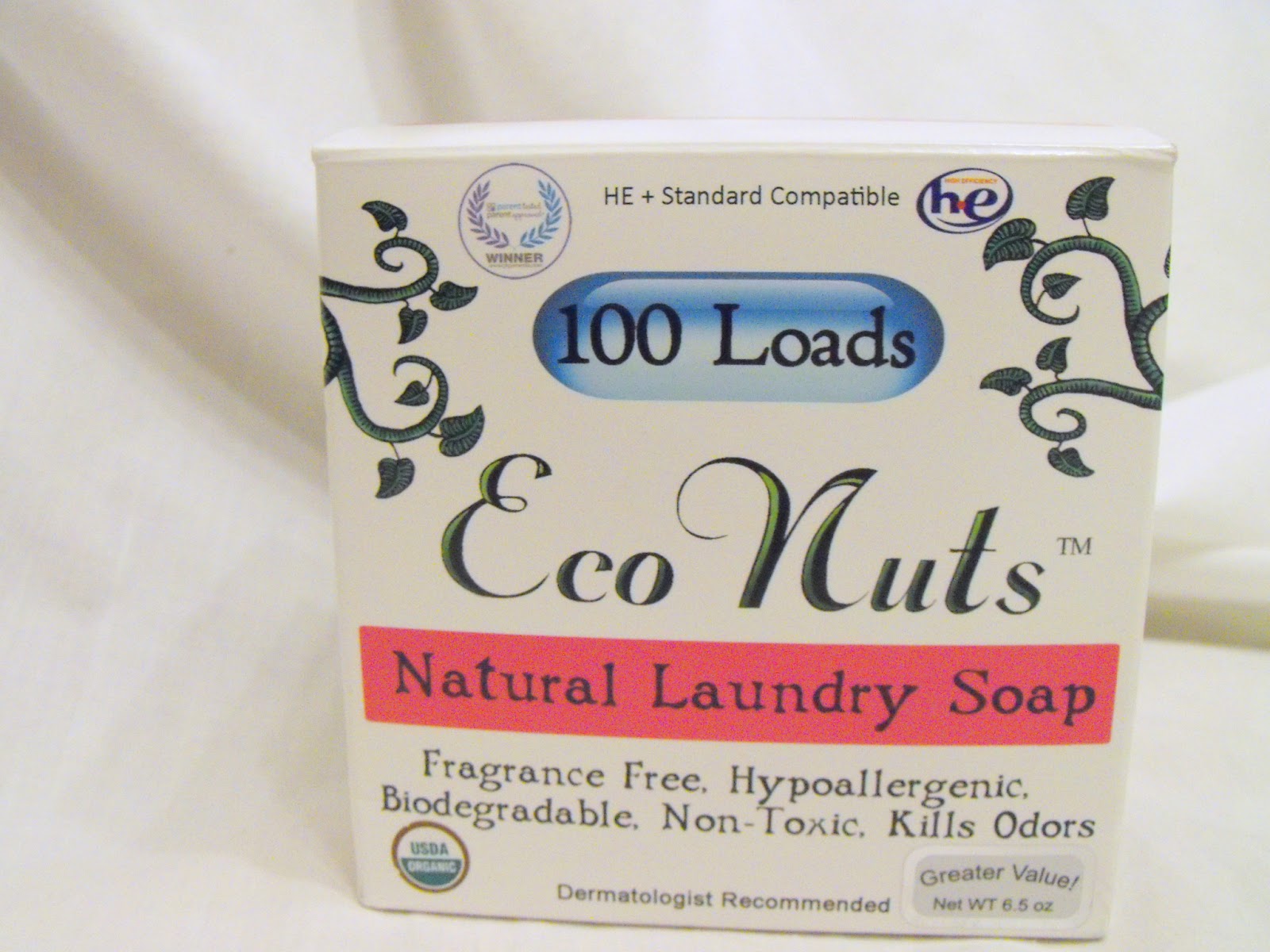
I bought my first batch of soap nuts from Amazon.  I had a $5 credit that was burning a hole in my pocket, so I purchased the 100 load box of Eco-Nuts.  It's a relatively small box packed full of these shiny, brownish-tan dried berries, along with 2 muslin sacks in which to place the berries. 
 
I just tried my first load of laundry, and I must say that I'm impressed!  The clothes came out clean, soft, and scent free straight out of the washing machine.  I did add a Gain fabric softener sheet to the dryer.  This is not necessary, as the saponin in the berries acts as a natural fabric softener; however, I have guys in my household, and let's just say that sometimes you NEED scented laundry. 

The berries work best in hot water or warm water but will also work in cold water, although there may not be as much saponin released.  So if you want to do a load of laundry in cold water but want to make sure there's enough saponin to ensure a clean load, try soaking or steeping the bag of berries in a cup of hot water for about 10 minutes prior to starting the wash load.  Then add the entire batch of water plus the bag containing the berries to the wash and proceed as usual.  

Overall, I thought they worked very well for a first- time use, and I am curious to see how well they work using them numerous times.  Regardless, this is a very economical and eco-friendly way to do laundry! 

Saturday, January 12, 2013

Homemade Disinfecting Sprays Like Lysol

It's that time of year again.  Time for colds, flu, and just general crud.  Everybody is cooped up, and it's easy to spread germs and viruses.  All three of us have been sick.  I started it, and the hubster and my son now have it.  We've tried hard to wash hands, keep everything swabbed with disinfecting wipes and sprays, but somehow we still managed to pick up a bug.  

The most important thing to remember is that good old soap and water do the best job of removing germs.  The surfaces are clean, and any remaining germs or viruses can be killed with disinfectants and other sanitizing agents.  While I love disinfecting wipes, they can't get everywhere.  That's when disinfecting sprays come in handy.  They form a fine mist that gets into nooks and crannies and can be sprayed so that there is even coverage.

Most disinfecting sprays do their best job when they are allowed to sit for a few minutes.  The optimal time is 5 minutes in order to kill everything.  Unfortunately, some of those sprays are not only expensive, they stink!  No matter how they are fragranced, it seems they still smell like chemicals. Blech! 

You can make your won disinfecting sprays at home and make them suited to your liking.  There are two recipes listed below.  One is an alcohol-based disinfecting spray.  The other is a paracetic acid spray.  The alcohol-based one is easier to make, is very effective at killing the flu virus, and is reasonably safe for all surfaces.  The paracetic acid mixture is acidic and contains peroxide so is not recommended for use on items that will bleach, such as fabrics. The CDC has deemed alcohol, peroxide, iodine-based products, and detergents as suitable substances for killing the influenza virus (link HERE). 

Finally, if you can stand the smell, a simple mixture of 1 tablespoon of bleach to 1 quart water or 1/4 cup bleach to 1 gallon of water is an effective germ and virus killer.  However, it is not safe for all surfaces, and... it stinks.  

Here are some alternative recipes for homemade disinfecting spray.  

Alcohol-Based Disinfecting Spray:
1 spray bottle 
isopropyl (rubbing) alcohol 70% (the regular stuff you buy in the store)
essential oils such as tea tree oil, lavender oil, rosemary oil, or peppermint oil 
OR
1 teaspoon Lysol cleaner or other disinfecting liquid cleaner

In spray bottle put either 15-20 drops of essential oil or 1 teaspoon of disinfecting cleaner.  Fill with alcohol and insert sprayer.  Shake gently to combine.  Spray on surfaces and allow to sit until dry.  

Paracetic Acid Based Disinfecting Spray:  
1 spray bottle
1/4 cup 5% white vinegar
1/4 cup 3% peroxide 
5 drops essential oil 
(Do not use cleaner with this solution.) 

Mix ingredients and carefully pour into a spray bottle and set sprayer to fine mist.  Spritz on hard surfaces that are not easily bleached or prone to damage from liquids.  Allow to sit until dry.  

Note:  This makes a small quantity.  If you need larger amounts, adjust ingredients accordingly by using 1 part vinegar to 1 part peroxide. 


For tips on preventing flu see this post from the CDC:  http://www.cdc.gov/flu/protect/stopgerms.htm


Thursday, January 10, 2013

Unusual Uses for Common Household Things


We all have little tips and tricks that we use.  I love finding unusual uses for items beyond their normal use.  Some of these may be obvious, some may be new, but they are fun and interesting.  

What little item do you use that is out of the ordinary?  I'd love to know what those are.  Here are some of mine: 


1.    Nail polish remover to take labels off plastic containers.  Saturate a paper towel with nail polish remover.  Wrap it around the item that needs the label or printing removed.  Allow to sit.  Periodically redampen the paper towel, then wipe off the label!  May also use furniture-grade acetone, for this, as well, but be sure to wear gloves. 

2.    Use an antiscratch scrubber kitchen sponge (the kind with a loofa on one side and sponge on the other) in the shower to remove calluses from feet.  If it gets icky, either put it on the top shelf of the dishwasher and run through with a load or put it in a zippered bag and wash it with a load of towels to get clean. 

3.    Aspirin, salt, and water paste for canker sore cure.  This is an old trick that my dentist gave to me long ago to treat canker sores.  Crush an adult aspirin into a powder.  Add an equal amount of salt.  Add enough water to make a paste.  Using a dampened Q-tip, dab a little on the canker sore.  This will burn like crazy, but it “cauterizes” the sore, and it will oftentimes be gone the next day.   (See medical disclaimer below.) 

4.    Make a paste of cooking oil and baking soda as a homemade “Goo Gone” to remove stains and other greasy residue. 

5.    Use white vinegar in your dishwasher’s rinse dispenser in stead of expensive commercial rinse products to stop hard water and soap spots.

6.    A crumpled piece of aluminum foil makes an excellent scrubber if no steel wool pads are available. 

7.    A muffin tin with each compartment filled halfway makes an excellent extra ice tray.  Fill with fruit punch, juice, tea, or Kool-aid for ice that won’t dilute in your drink. 

8.    Use Rain-X meant  to use for windshields on shower doors.  Water spots won’t form, and the shower glass will be easier to clean.

9.    Use car wax to wax sinks and showers.  Clean shower stalls and sinks, then apply a coat of car wax and buff.  This will leave a shiny surface, and soap scum won’t stick to it.

10. Use a sheet of Contact paper with the backing removed for furniture, clothes and car seats to make dog hair and lint pickup an extra quick task. 

11. Want extra long eyelashes?  Clean an old mascara wand, and use it to apply either mineral oil, baby oil, or Vaseline to your eyelashes each night.  This will condition them and help them grow. 

12. Aluminum foil makes a great connector/contact point  if a spring breaks inside a battery compartment of a piece of electronics or a toy. 

13. Mix coffee grounds (used or fresh) and olive oil and use for a facial or body scrub.  The grounds provide an exfoliating effect, the caffeine will help tighten skin and improve circulation, and the olive oil provides moisture.  Rinse well after use.

14. Spray Static Guard on your hair brush to relieve static in your hair or use a fabric softener sheet gently rubbed over your hair to help detangle it.

15. Got stuck-on, burned-on food in a pan or casserole dish?  Place a fabric softener sheet in it, then fill the pot or dish with hot water, and allow to sit overnight.  The gunk will wash off!

16. Got an old T-shirt that is a little on the snug side?  Use it to dry your hair!  Pull just the neck over your head, with the shirt going in the wrong direction, then use the remaining T-shirt to wrap up your hair.  This will dry your hair quickly, hold your hair up while you apply makeup, and is even more gentle than a bath towel. 


Medical disclaimer:  Material on this Website is provided for informational purposes only. It is not a substitute for medical care, consultation, or advice.

Easy Kitchen Cleanup while Cooking


Some friends and I were having a discussion recently about whether or not we like to cook.  A couple said they wouldn't mind cooking if it didn't make such a mess.  I piped up because one thing that I learned, when I was learning to cook, was how to clean as you go. 

Now, let's get one thing straight.  I... AM... A.. SLOB.  No ifs, ands, or buts.  I would rather do anything that clean, my house is a disaster, and a scatter bomb going off would be an improvement.  As someone once said, "A lazy person will find the fastest way to do something."  That would be me.  

However, one thing I'm weird about is my kitchen.  While there might be clutter around, the kitchen itself will be clean.  I cannot start cooking unless the kitchen is clean first.  Weird, huh? 
I told them my tips for cleaning as I go while I cook, and a friend suggested a blog post.  So here we go! 

Steps to Cleaning while Cooking: 
  • Put away any clean dishes in the dishwasher.
  • Empty the sink and counter spaces and put all dirty dishes in the dishwasher.
  • Plug the sink and squirt in a little dish soap.  Run the sink about half full of soapy water. 
  • As you cook and use bowls, utensils, etc., put them in either the sink or the dishwasher.
  • Hang a Walmart sack or trash sack over either a cabinet drawer or cabinet door to secure it.  Hang it near where you are cooking. Dump empty cans, packaging, or scraps in as you cook so that you are not moving back and forth between the trash can. 
  • Open any cans needed for a recipe.  Drain, if needed.
  • Save an empty can into which you can pour drippings from cooked meat, such as hamburger meat. Toss the can when contents are cool. 
  • Chop any veggies that need to be chopped.
  • Cut up and/or rinse any meat needed in the recipes. 
  • Use a spoon rest or folded up dampened paper towel on which to lay any utensils while you cook to prevent drips and spots.  
  • As you use something, put it either in the soapy water in the sink, or put larger items in the dishwasher.
  • When finished cooking and serving your meal, you can empty the sink and either place soaked items in the dishwasher or give them a quick scrub, rinse, and dry to put them away.  
  • Collect trash sack full of items and discard. 
  • Wipe down stove/oven, counters, let water out of sink and scour. 
You're done! 


Sunday, December 16, 2012

The Multiple Uses for Castile Soap

Rarely is there truly one all-purpose cleaner.  One of my favorite cleaning agents is castile soap.  Not only is it wonderful to use to clean your home, it is also an excellent gentle, nontoxic, and soothing soap to use for body wash or shampoo.  It is that versatile!  It is also very economical in that one small bottle can be used to create many different cleaning products, and it is ultra concentrated, so a little bit goes a very long way. 

Castile soap is made from oils obtained from plant origins (as opposed to those from animal origins) such as coconut, hemp, or olive oil, to name a few.  It has been prized throughout history as being a gentle but effective cleaner. It is also considered to be "green" in that it contains natural cleaners as opposed to harsh chemicals.

My preference is Dr. Bronner's Pure Castile Soap liquid, and I like the lavender scent, although they have many other scents including citrus, peppermint, tea tree, and even a scent for babies.  There are also bar forms of this soap that can either be used in their solid form or grated into flakes for use in other items. 

My favorite use is in the laundry.  It only takes a relatively small amount of the soap added to your wash to get your clothes clean and soft.  It is an excellent pretreatment for stains, particularly oily stains.  There have been some spots on clothing that seemed to be set in, and I've saturated them with a small amount of the liquid Castile soap, worked it into the cloth fibers with a toothbrush, and then laundered, and the stain has come right out.   

Mix a tiny amount of the soap with water and place into a spray bottle then use to clean countertops.  Follow with a light white vinegar and water rinse for a sparkling clean surface.  (Of note, do not mix white vinegar and castile soap together, as the vinegar desaponifies the soap, rendering it ineffective.  More information HERE.) 

Here are some other uses and recipes below. 

Body wash:  Place a few drops of liquid soap onto a bath pouf and work into a lather, then use all over body.  Rinse thoroughly.   You can make your own body wash by grating 1 bar of Dr. Bronner's or Kirk's Castile Soap and mixing it with 6 cups hot water in a large pot, then heat and stir until combined.  Pour into bottles to use as body wash.

Laundry Spot Treatment: Use as a spot treatment for tough stains, or add 1-2 squirts to your laundry for a cleaning boost.  

Liquid Laundry Detergent:  3/4 cup Dr. Bronner's liquid castile soap, 1/2 cup super washing soda (not baking soda), 1/2 cup 20 Muleteam Borax, 1 gallon HOT water plus 1 gallon cold water.  Place dry ingredients in a large bucket and add 1 gallon of water.  Mix until borax and washing soda are dissolved.  Add liquid castile soap, stir well, and then add remaining cold water.  Allow to cool, stirring periodically.  Pour cooled liquid soap into containers and use 1/3 to 1/2 cup per wash load.  (Recipe found HERE.)

Homemade Shaving Cream:  Mix 2-3 drops of castile soap with baby lotion, then slather on prior to shaving, shave, and rinse.  Skin will be silky smooth. 

Homemade Soft Scrub:  Mix 1 part castile soap to 3 parts baking soda, then use as a nonscratching scouring powder for skins, stoves, bathtubes, etc.

Homemade Liquid Hand Soap:  Mix 1 teaspoon castile soap with 1 cup water and place in old soap dispenser.  This particularly is particularly fun in foaming soap dispensers. 

Dog Wash:   Add a few drops of castile soap to Fido's bath to get him clean and leave his hair silky smooth. 

Shampoo:  I have heard that this can be diluted and used as a shampoo.  However, I understand it is necessary to use white or cider vinegar diluted with water as a rinse, otherwise it will leave a residue on hair.  I have not tried it myself, but I have heard others rave about it, especially those prone to seborrheic dermatitis.  

Floor Cleaner:  Mix 2-3 Tablespoons of liquid castile soap with 1 gallon of water and use to mop floors. 

Garden Pest Treatment:  Mix 1-2 tablespoons of castile soap with water and place in a spray bottle.  Use to spray on plants to kill pests such as aphids.

To find Dr. Bronner's Liquid Castile Soap, check link hereOrganic Castile Liquid Soap Lavender - 32 oz (Google Affiliate Ad),or Soap.com, drugstore.com, or Amazon.  

Sunday, November 25, 2012

Homemade Clorox Cleanup


I love Clorox Cleanup.  It cleans, it whitens, it disinfects, and it leaves a nice smell that is more than just the smell of bleach.  What I don't like is the price.  

I found a great recipe to make this wondrous cleaner at home at the blog HERE.  I modified the ingredient amounts just a little bit, but otherwise the recipe is just the same.  Best of all, it works just as well as the original product, but at a fraction of the cost. 

You will need: 
1 empty spray bottle 
1/2 Cup bleach
2 tablespoons dish soap 
Water*

Pour bleach into empty spray bottle.  Fill the bottle almost all the way full of water, leaving about 1 inch of room.  Then add the dish soap.  Insert the sprayer, seal the bottle, and then gently tip the bottle back and forth about 20-30 times to mix the ingredients.  If you add the dish soap and then pour in the water, your ingredients will bubble out, so it's best to fill the bottle then add the soap.  

*We have hard water, so it always requires a bit more cleaning ingredients than most recipes establish.  If you have relatively soft water (i.e., with very little mineral content), you might be able to reduce the bleach to 1/4 cup and the dish soap to 1 tablespoon.  

That's all it takes!  Now you can clean, freshen, and disinfect your counter tops, sinks, and bathrooms, but without all the expense! Happy cleaning!

Sunday, November 18, 2012

Freshen The Air While You Vacuum


If you've ever started to vacuum and then decided that things could smell better, there's an easy way to freshen the air while you vacuum.  Tear off a small corner of a paper tissue, such as Kleenex, and put 1-2 drops of essential or other scented oil on the tissue.  Drop it on the floor, then vacuum it up.

The scent will be released through your vacuum while you're working, freshening the air as you go. 

You can also place 1-2 drops of oil on a light bulb in a lamp, then turn the lamp on, and the scent will be released.  There may be a little vapor that arises as the bulb heats (may resemble smoke), but this is normal.  Do not put more than a drop of oil on the bulb, and never drop it on a bulb that is already lit or the bulb may shatter. 

Both ways will quickly freshen the air and give a longer lasting scent than room sprays.  Vacuuming up the scented tissue also freshens the vacuum, especially if you have pets and the smell lingers in the vacuum. 


Sunday, November 11, 2012

Homemade Glass Cleaner


I rarely, if ever, buy glass cleaner.  Actually, I can't remember the last time I bought it.  Instead I make my own.  It's much more economical, and it's easy to make a batch whenever you want.  Every time I make glass cleaner, I am baffled at how expensive it is in the store compared to how inexpensive it is to make at home

You can either use an old glass cleaner bottle that's been rinsed out or pick up a couple of spray bottles at the dollar store. I have two different recipes I use.  One is for harder to clean stuff (like doggie nose slobbers), and the other is for mild cleaning just to freshen up the windows. 

Here are two recipes: 

Fake Windex 

2-3 tablespoons nonsudsing ammonia*
1/2 cup (4 oz). rubbing alcohol 
Water
1 drop dish soap, no more, no less (can omit but solution doesn't clean as well)

Put ammonia and alcohol in a spray bottle.  Fill almost full with water.  Leave about 1/2 inch of space below the top, then add the 1 drop of dish soap.  Put sprayer on the bottle and tighten.  DO NOT SHAKE.  Instead, tilt back and forth about 20-30 times to mix.  It might be temping to dump all this in the bottle, but if you begin to add water, the dish soap will foam up, and your ingredients will start spilling out of the bottle.  You will recognize the smell of this, as it will smell just like Windex.  You can even add a drop or two of blue food coloring, just for fun.  


Window Cleaner Recipe #2

Approximately 1/2 cup white vinegar*
Water

That's it!  Put the vinegar in a spray bottle and add enough water to fill the bottle.  Cap with the sprayer mechanism, then shake to combine.  This works great but can smell like vinegar while you're using it.  The vinegar smell leaves once everything dries.

I currently use the vinegar solution with microfiber cloths.  These work great because they only require a small spritz of cleaner to clean a whole  window, and they're very absorbent, so you only need one cloth to clean many windows.  Combine the two, and you only need a small squirt of cleaner, and the windows come out clean, shiny, and streak free. 


*Keep in mind that if you have hard water (i.e., water that contains a lot of minerals or metal particles) you may need more ammonia or vinegar.  These recipes are flexible enough that you can adjust them for your cleaning needs. 

Sunday, November 4, 2012

Scouring Powder Alternative


We all know there are things that just need a good scrubbing or scouring sometimes.  This is an alternative to the harsh scouring powders that contain bleach (Comet, Ajax, etc.).  It's simply blue Dawn dish soap and baking soda.  Honestly, there aren't too many things that I haven't used Dawn and baking soda to clean.  There will be more of those in later posts, but for now, we'll start with this.  

In order to make your own scouring alternative, using a damp sponge or soft cloth.  Squirt a little Dawn on the sponge or cloth, then sprinkle with baking soda and scrub the surface.  Scrub as you would with a scouring powder, then rinse thoroughly with water.

This works great for things like the bath tub, shower tiles, kitchen sink, counter tops, and I have even used it as cleaner to get bug splats off the front of my car without scratching the paint.  I have been told that it is also acceptable for cleaning flat-topped stoves, though I have not tried it myself, so use at your own risk. 

While it will not necessarily bleach stains, it will remove any substances that are stuck on and does a great job of dissolving oils and soap scum left behind in showers. I like to use it on my stovetop to get the tough, baked-on spills left after cooking.  

It leaves a fresh, clean scent.  It is nontoxic.  It's "green."  It won't hurt septic systems.  It's readily available whenever you need it, and it's economical.  It also cleans great, and is nowhere near as expensive as other scouring powders!