Search

Powered by Blogger.

Networked Blogs

Showing posts with label laundry. Show all posts

Friday, August 16, 2013

Shelf Life of Household Chemicals


Ever wonder why your favorite cleaning or household product just didn't seem to do the trick any more? Have you added bleach to your laundry whites only for them to come out as grungy as they were when they went in?  Get a great deal on dish soap, stock up, and then discover that your dishes aren't getting clean?  Your household cleaners might be past their shelf life.

Some items will store indefinitely, but other items lose their effectiveness after a period of time.  Some of those times are surprisingly short. I began looking into shelf life/storage possibilities when I started avidly couponing and stockpiling.  There are some things that I discovered might expire before it could be used, so I keep this information in mind when making my purchases. 

Household bleach is an excellent example of this.  It has a relatively short shelf life of around 3-6 months.  That may seem like a long time, but that is from date of manufacture.  Bleach also looses its umph when exposed to heat.  So if the bleach was bottled, put onto a semi truck, trucked across the country, then stored in a stockroom of a retail store, it will probably need to be used fairly quickly.  The bleach will not look or smell any different; however, if you have used bleach and it just doesn't seem to be doing its job any more, it may very well be outdated.  

Keep in mind that it's not as if a bomb goes off inside a bottle or package of an item that it automatically becomes ineffective on a certain date; however, it is a guideline of which to be aware so that you will know whether a product is going to be effective or if it might need to be tossed and purchase something new. 

Here is a list of other household items and their shelf lives: 

Acetone (in nail polish remover):  Unopened 1 year; opened 6 months. 

Ammonia, household:   Indefinite.  Will evaporate if left uncapped. 

Baking Powder :  Indefinitely unopened; 9-12 months opened (Check by adding 1/4 teaspoon to 1/2 cup very hot water.  If it does not begin fizzing, it's out of date and will no longer work.) 

Baking Soda:  Indefinitely unopened; 3-4 years opened however slowly loses its umph the longer it is exposed to air.  (Check by adding 1/4 teaspoon plus 1/4 teaspoon vinegar to 1/2 cup very hot water.  If it does not begin fizzing, it's out of date and will no longer work.) 

Bath Soap, bar:  18 months to 3 years. 

Bath Soap, liquid:  1 year; antibacterial soap loses its effectiveness in about 9 months.

Borax (laundry):  Indefinitely, according to the 20 Muleteam Borax website; however, it will clump/lump if opened and exposed to damp or humid conditions.  

Bleach, chlorine:  3-6 months if unopened; shorter if opened and/or exposed to heat. 

Castile soap, liquid or bar:  Approximately 3 years.  (Per Dr. Bronner's website.)

Citric Acid, powdered (active ingredient in Lemishine):  3 years from date of manufacture.  Will degrade faster with exposure to heat and moisture/humidity.  

Coconut Oil:  1-1/2 to 2 years before becoming rancid.  

Conditioner, hair:  3 years unopened; 12-18 months if opened.  May become rancid if conditioner contains oils and is exposed to heat. 

Dish Detergent, Liquid or Powder:  1 year unopened; 9-12 months opened.  

Fabric Softener, liquid:  2-3 years unopened; 1 year opened.

Fabric Softener sheets:  Indefinite though may gradually lose their scent. 

Hydrogen Peroxide 3% (as sold in drug/retail stores):   Good for 1 year unopened but only 30-45 days once opened.  (?!  Yes, it's true!)  It may still fizz but loses its strength over a period of time.  The older it is, the weaker it becomes.  It also loses its potency with exposure to light, which is why it comes in dark brown bottles.  It can last longer if stored in a cool, dark place, but once it begins to lose its fizz, toss it or use it up. 

Isopropyl (Rubbing) Alcohol:   Approximately 1-2 years.  There is a belief that this stays good forever; however, that is untrue.  It eventually oxidizes via air exposure and turns into acetone.  Refer to expiration date on bottle.  

Laundry Detergent, Liquid or Powder:  Unopened up to 1 year; opened 6 months.   

Lemon Juice, fresh:  2-4 days; 3-5 months if frozen. 

Lemon Juice Concentrate: Up to 6 months in the fridge; 1 year if frozen.

Nail Polish remover, acetone based:  1 year unopened; 6 months, opened. 

Nonchlorine Bleach (i.e., Clorox2):  Up to 1 year unopened, 6 months when opened (contains hydrogen peroxide as the active ingredient).  

Olive Oil:  2 years unopened, 1 year after opening.  Will become rancid.  Olive oil becomes cloudy when refrigerated. 

Oxygen Bleach (OxiClean):  Indefinite if kept in sealed container. 

Shampoo:  Unopened 3 years.  Opened 12-18 months.  May possibly become rancid if it contains certain oils. 

White Vinegar/Cider Vinegar:   Indefinite.  This is why vinegar is used as a preservative for canning. 

Washing Soda (soda ash):  Indefinite.  However, again, if exposed to damp or humid conditions can clump and degrade.  *Note, this is different from baking soda and is used specifically for laundry.  *

For a list of 77 items and their expiration dates, check this link:  http://www.realsimple.com/home-organizing/surprising-expiration-dates-10000000676079/print-index.html

Saturday, February 9, 2013

Homemade Laundry Soap Using Liquid Castile Soap

Have you ever tried making homemade laundry soap?  I have, many times, with varying results.  I finally found a recipe that works for me that I'm going to share here.  Most recipes use simple, easily obtained ingredients that are sold in either local grocery/department stores or available online. I like being able to make my own laundry soap because it gives me a sense of accomplishment that I've made something useful.  (I am woman, hear me roar and all that!)  I also like knowing that, in a pinch, if I need to, I can whip up something to do a load or two of laundry in case I run out of laundry soap. 

I've found, however, that homemade laundry soap is one of those things that people either love or hate.  They have mixed reasons for trying it.  Some people do it for economic reasons, some for environmental reasons, and some for personal reasons such as having sensitive skin. Other people have tried it and rejected it because they felt it didn't clean their clothes well, it didn't smell right, or it was more work than they were willing to do.  If you are willing to stick with the process, you can often adjust the ingredients to develop a laundry detergent that works for you and your situation. 

Most recipes call for a grated bar of some sort of soap such as Fels Naptha, Zote, Kirk's Castile soap, or Ivory Soap along with water softeners and laundry boosters such as washing soda or borax.  Grating a big old bar of soap can be tedious, even with a food processor, because once everything is mixed, most people prefer to run it through the food processor yet again to grind the mixed ingredients into a fine powder. That's kind of pain.  If you don't have a food processor, you'll have big curls of soap shavings in your dry mix.  That is unless you use the liquid soap recipe.    That tends to make a big, gooey bucket of laundry soap akin to slime.  However, there are recipes using liquid soap that are very easy to make, work well, and are very gentle.  

My favorite recipe uses Dr. Bronner's liquid castile soap.  It comes together very quickly.  It's easily mixed, it's not messy, it's not slimy, and it is has concentrated cleaning power in a very pourable consistency.  The recipe is below, with some notes.  

HOMEMADE LIQUID LAUNDRY SOAP WITH CASTILE SOAP
1 cup very hot water
1 cup Dr. Bronner's castile soap, any scent 
1/2 cup washing soda*
1/2 cup borax*
1 gallon clean, empty container

INSTRUCTIONS:  Place borax and washing soda in a small pitcher or cup (easier to pour).  Add 1 cup very hot water (or more) and stir until washing soda and borax have dissolved.  Pour into gallon container.  Add castile soap.  Do not shake!  Cap container and tilt back and forth to mix soap, washing soda, and borax.  Remove cap and slowly add cold water until container is full, leaving enough room to mix.  Again cap container and tilt back and forth to mix.  Allow to cool, shaking periodically to blend.  This will be a very thin, watery detergent, but it works very, very well and has a wonderful scent.  

If you shake the ingredients before filling the container with water, it will make suds.  Then when you add the cold water, it may overflow the container.  Tilting the container back and forth several times will mix the ingredients without generating suds.

TO USE:  Measure out 1-2 tablespoons of laundry soap into dispenser or bottom of washing machine, and launder as usual. You may need as much as 1/4 cup if there are tough stains or the laundry is extra dirty. 

*NOTE:  The standard recipe calls for 1/2  cup each of washing soda and borax.  I have found that for our type of water, it is better to adjust the ingredients to be 3/4 cup washing soda and 1/4 cup borax because we have a high calcium content in the water so need a laundry additive that has a higher acidity.  If you use the regular recipe and find your clothes are not getting clean, try adding 1/2 cup of white vinegar or 1/2 cup lemon juice to the wash to further soften water and chelate any metals present in your local water supply.  

Tuesday, January 29, 2013

Soap Nuts for Laundry

I am always searching for new ways of doing things, less expensive things, things that are also ecologically friendly, and things that are just awesome.  Soap nuts are delightful natural cleaning product that is excellent for use in the laundry or for making all-natural cleaning products! Ever since I saw mention of them on an internet forum which I visit, I've been curious, so I did some research and decided to give them a try. 

Soap nuts are berries, or technically a drupe, from the Sapindus tree or shrub (Sapindus Mokorossi).  They grow naturally in the Himalayas and produce saponin.  That is a natural surfactant that changes the surface tension of water and allows the water to get into the fibers of clothing, break down dirt, and float it away.  If you use soap nuts in your laundry, there are no suds.  Instead, the dirt breaks down, the water looks dirty, but the clothes are clean.  The dirt simply goes down the drain with the rest of the waste water.  There is no smell/scent, and soap nuts are very gentle, so they're perfect for baby clothes, diapers, or for those who have sensitivities to soaps, detergents, or fragrances. They are "green," eco-friendly, and are safe for septic and sewage systems. 

The best part is that you can get multiple uses from just a few of the berries.  They can be reused up to 10 times before they disintegrate and need to be replaced.   Just remove the berries from the load of laundry once it's finished, leave them in their bag, allow them to dry, and reuse with your next load.  When the berries become very thin and crumble, it's time to replace them.

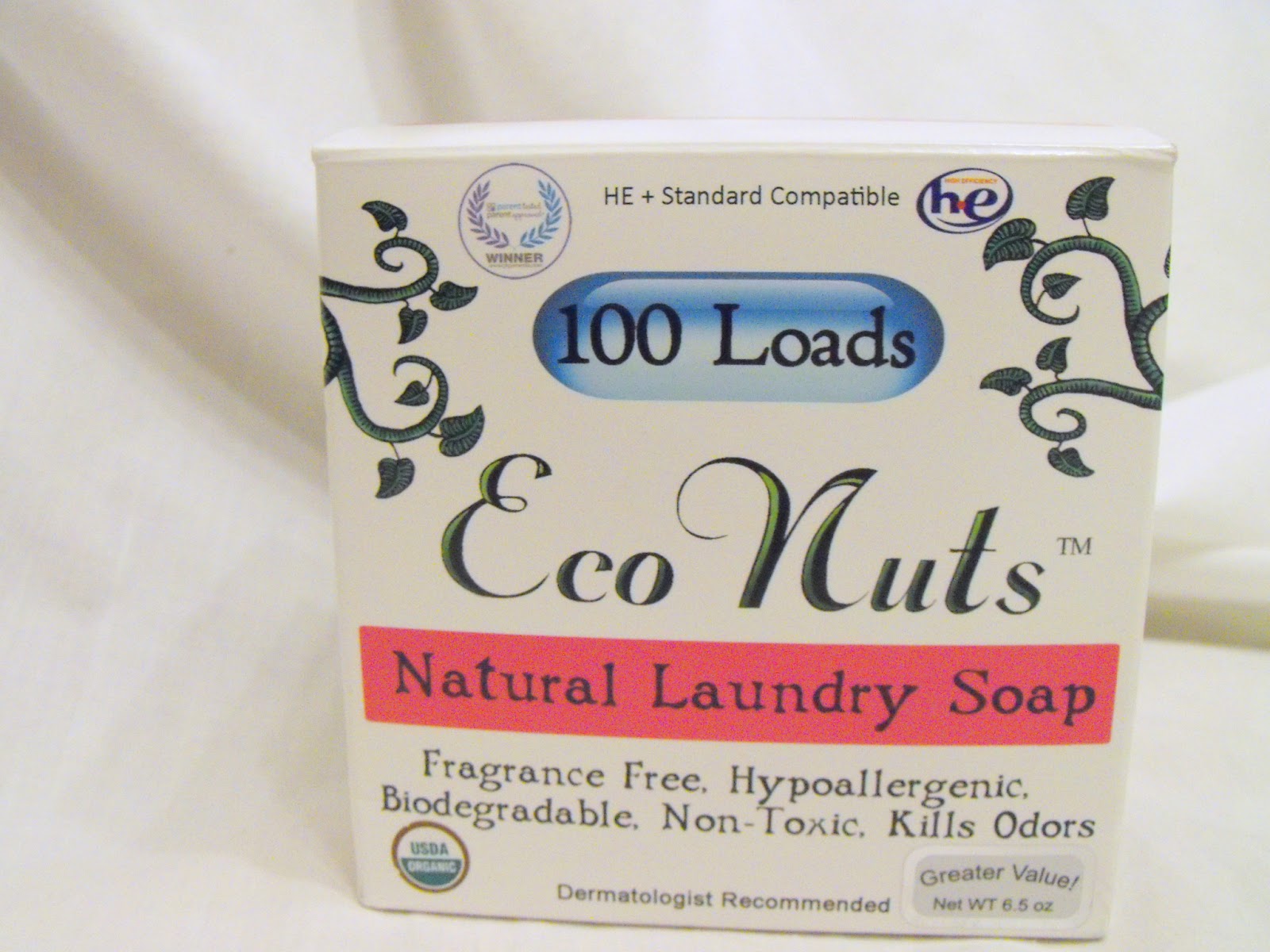
I bought my first batch of soap nuts from Amazon.  I had a $5 credit that was burning a hole in my pocket, so I purchased the 100 load box of Eco-Nuts.  It's a relatively small box packed full of these shiny, brownish-tan dried berries, along with 2 muslin sacks in which to place the berries. 
 
I just tried my first load of laundry, and I must say that I'm impressed!  The clothes came out clean, soft, and scent free straight out of the washing machine.  I did add a Gain fabric softener sheet to the dryer.  This is not necessary, as the saponin in the berries acts as a natural fabric softener; however, I have guys in my household, and let's just say that sometimes you NEED scented laundry. 

The berries work best in hot water or warm water but will also work in cold water, although there may not be as much saponin released.  So if you want to do a load of laundry in cold water but want to make sure there's enough saponin to ensure a clean load, try soaking or steeping the bag of berries in a cup of hot water for about 10 minutes prior to starting the wash load.  Then add the entire batch of water plus the bag containing the berries to the wash and proceed as usual.  

Overall, I thought they worked very well for a first- time use, and I am curious to see how well they work using them numerous times.  Regardless, this is a very economical and eco-friendly way to do laundry! 

Sunday, January 27, 2013

Laundry and Dishwashing Additives to Help Combat Hard Water


Have you ever done a load of dishes in the dishwasher only to have them come out spotty and with bits of food still on them after using your favorite dishwasher detergent?  Or have you done a load of laundry only to discover that your items just were not as clean as they need to be?  It's not a problem with your dishwasher or your washing machine.  It's also not a problem with your favorite dishwasher soap or laundry detergent... well, not technically.  

In 2010, a ban went into effect prohibiting the use of phosphates in dishwasher detergent.  It began in 17 states.  The phosphates were getting into the water supply and causing the growth of algae, so they were banned.  (Link HERE.)However, because of the expense associated with trying to manufacture one type of detergent for some states and a different type of detergent for other states, the manufacturers made the decision to just make one type of dish detergent:  phosphate free.  Phosphates were removed from laundry detergents in 1993.  

It's a win for the environment, but it's a loss for trying to get your dishes and laundry clean. Trisodium phosphate is a degreaser, soap scum buster, and left sparkling clean dishes and fresh laundry.  Unfortunately, once that was removed from these soaps, things were not good.  Pans came out dingy, aluminum turned black, fingerprints and lipstick were still present on dishes and glasses.  Some laundry soaps left clothes looking like they'd not even been washed.  Water could have done as good a job.  What's worse, if you live in an area of the country that has hard water, your dishes may have begun showing a filmy, milky, powdery residue, and your whites may have begun to be dingy.  

What can a person do?  Short of adding trisodium phosphate to these soaps, there are other options for combating these problems.  They are additives that can combat the minerals, metals, and other compounds found in water, allowing the detergents and soaps to do their jobs.  Here are some of them. 
 
Citric Acid -Citric acid is what makes lemon juice tart.  It has many uses not only in cleaning but in food and food preservation.  For cleaning, it serves as a chelating agent, binding to minerals and especially metals in hard water.  It makes an excellent additive to both the washing machine and the dishwasher.  It is the main active ingredients in dishwasher rinse aids such as LemiShine (If you want to read a fun chemist's breakdown of LemiShine, read the link HERE.)  Add 1-2 tablespoons to laundry to help laundry get cleaner, or add 1-2 teaspoons to your dishwasher for crystal clear glassware and spot-free dishes.  You don't have to buy LemiShine.  Instead, you can buy straight citric acid from places like Amazon.com, or find it in the canning aisle of your favorite grocery store, although buying it that way is quite expensive.  You can also buy it in bulk from Soap.com.  

Lemon Juice - Nature's own citric acid. (See note above.)  Add 1/4 cup to your laundry or dishwasher. 

White Vinegar - Acetic acid in water.  This is an excellent mild acid that dissolves calcium and makes it water soluble.  It is excellent for adding to laundry to increase the water's acidity.  It breaks down minerals contained with hard water, and it also helps to dissolve any residual soap scum left from laundry.  It is an excellent substitute for a fabric softener by adding it to the final rinse of a load of laundry.  Use anywhere from 1/2 to 1 full cup.  It is also a wonderful substitute for spotfree treatments in your dishwasher.  Just fill the rinse compartment with white vinegar and use as you normally would the rinse solution. 

Washing Soda - Sodium carbonate or soda ash.  Not to be confused with baking soda, which is sodium bicarbonate. Sodium carbonate bonds with magnesium and calcium ions in hard water and prevents them from bonding with detergent.  This allows the detergent to do its job and for your clothing to get cleaner.  It also raises the pH of water.  If you're a pool owner, you are familiar with The pH Plus product sold in stores to raise the pH.  Raising the pH also allows detergents to clean better.  (Link HERE.) Add approximately 1/4 to 1/2 cup to your laundry to help soften water and achieve better detergent results. 

Borax -  Sodium borate, sodium tetraborate, or disodium tetraborate.  Prevents calcium and magnesium from binding with detergent and rendering it ineffective.  (Link HERE.)  However, unless you use hot water, borax can be difficult to dissolve and can leave powdery granules in your washing machine, so it may not be your first choice to use if you have hard water.


Sunday, December 23, 2012

Best Homemade Stain Remover

Ever been tempted to throw away a perfectly good article of clothing just because it has a stain?  There are times when clothes get grungy looking, or you find yellow armpit stains, or there is a ring-around-the-collar issue.  Maybe you dropped a dollop of tomato sauce on your favorite white shirt.  Or maybe you have a grease stain on that pretty turquoise blouse.  Rather than buying expensive stain removers, you might have everything you need right in your kitchen cabinets. 

I had seen this post at One Good Thing by Jillee for armpit stain remover.  It works great for whites and takes out more than yellowed armpit stains.  BUT, if you have colored clothing, hydrogen peroxide is not the ideal thing as peroxide can bleach colors.  Never fear!  There are alternative solutions.  

Here is the recipe for the original stain remover for white clothing:
  • original blue Dawn dish soap
  • hydrogen peroxide 
  • baking soda
Mix the Dawn dish soap and baking soda to form a paste.  Using an old toothbrush or other type of brush, work the Dawn/baking soda mixture into the stain.  Let it sit for a bit.  Then saturate the area with hydrogen peroxide.  This will bubble like crazy.  Allow this to sit, again, for about 10-15 minutes.  Throw in the washing machine with other whites and launder on the hottest setting the fabric can tolerate.  Stains should be gone.  

I also keep a mixture of equal parts Dawn and peroxide in an opaque spray bottle to use as a pretreatment prior to washing.  An opaque bottle is important, as peroxide begins to break down or deteriorate if exposed to light.  That's why it comes in a dark brown bottle in the store.  

Now, for the color-fast stain remover!

Color-fast stain remover: 
  • original blue Dawn dish soap
  • white vinegar
  • baking soda
Make a paste with the Dawn and baking soda.  Using a toothbrush or other bristled brush, work into the stain.  Allow to sit for about 10-15 minutes.  Once time is up, saturate stained area with white vinegar.  This will bubble considerably.  Once bubbling has stopped, launder clothing as directed.  

There you have it!  These are two inexpensive and easy ways to get stains out of clothing without resorting to expensive laundry pretreatments at the store! 

Sunday, December 16, 2012

The Multiple Uses for Castile Soap

Rarely is there truly one all-purpose cleaner.  One of my favorite cleaning agents is castile soap.  Not only is it wonderful to use to clean your home, it is also an excellent gentle, nontoxic, and soothing soap to use for body wash or shampoo.  It is that versatile!  It is also very economical in that one small bottle can be used to create many different cleaning products, and it is ultra concentrated, so a little bit goes a very long way. 

Castile soap is made from oils obtained from plant origins (as opposed to those from animal origins) such as coconut, hemp, or olive oil, to name a few.  It has been prized throughout history as being a gentle but effective cleaner. It is also considered to be "green" in that it contains natural cleaners as opposed to harsh chemicals.

My preference is Dr. Bronner's Pure Castile Soap liquid, and I like the lavender scent, although they have many other scents including citrus, peppermint, tea tree, and even a scent for babies.  There are also bar forms of this soap that can either be used in their solid form or grated into flakes for use in other items. 

My favorite use is in the laundry.  It only takes a relatively small amount of the soap added to your wash to get your clothes clean and soft.  It is an excellent pretreatment for stains, particularly oily stains.  There have been some spots on clothing that seemed to be set in, and I've saturated them with a small amount of the liquid Castile soap, worked it into the cloth fibers with a toothbrush, and then laundered, and the stain has come right out.   

Mix a tiny amount of the soap with water and place into a spray bottle then use to clean countertops.  Follow with a light white vinegar and water rinse for a sparkling clean surface.  (Of note, do not mix white vinegar and castile soap together, as the vinegar desaponifies the soap, rendering it ineffective.  More information HERE.) 

Here are some other uses and recipes below. 

Body wash:  Place a few drops of liquid soap onto a bath pouf and work into a lather, then use all over body.  Rinse thoroughly.   You can make your own body wash by grating 1 bar of Dr. Bronner's or Kirk's Castile Soap and mixing it with 6 cups hot water in a large pot, then heat and stir until combined.  Pour into bottles to use as body wash.

Laundry Spot Treatment: Use as a spot treatment for tough stains, or add 1-2 squirts to your laundry for a cleaning boost.  

Liquid Laundry Detergent:  3/4 cup Dr. Bronner's liquid castile soap, 1/2 cup super washing soda (not baking soda), 1/2 cup 20 Muleteam Borax, 1 gallon HOT water plus 1 gallon cold water.  Place dry ingredients in a large bucket and add 1 gallon of water.  Mix until borax and washing soda are dissolved.  Add liquid castile soap, stir well, and then add remaining cold water.  Allow to cool, stirring periodically.  Pour cooled liquid soap into containers and use 1/3 to 1/2 cup per wash load.  (Recipe found HERE.)

Homemade Shaving Cream:  Mix 2-3 drops of castile soap with baby lotion, then slather on prior to shaving, shave, and rinse.  Skin will be silky smooth. 

Homemade Soft Scrub:  Mix 1 part castile soap to 3 parts baking soda, then use as a nonscratching scouring powder for skins, stoves, bathtubes, etc.

Homemade Liquid Hand Soap:  Mix 1 teaspoon castile soap with 1 cup water and place in old soap dispenser.  This particularly is particularly fun in foaming soap dispensers. 

Dog Wash:   Add a few drops of castile soap to Fido's bath to get him clean and leave his hair silky smooth. 

Shampoo:  I have heard that this can be diluted and used as a shampoo.  However, I understand it is necessary to use white or cider vinegar diluted with water as a rinse, otherwise it will leave a residue on hair.  I have not tried it myself, but I have heard others rave about it, especially those prone to seborrheic dermatitis.  

Floor Cleaner:  Mix 2-3 Tablespoons of liquid castile soap with 1 gallon of water and use to mop floors. 

Garden Pest Treatment:  Mix 1-2 tablespoons of castile soap with water and place in a spray bottle.  Use to spray on plants to kill pests such as aphids.

To find Dr. Bronner's Liquid Castile Soap, check link hereOrganic Castile Liquid Soap Lavender - 32 oz (Google Affiliate Ad),or Soap.com, drugstore.com, or Amazon.  

Sunday, December 9, 2012

How to Get Liquid Fabric Softener to Stretch Further

I love liquid fabric softener.  I especially love the scent of Gain, but there are two things I don't like.  First, it's expensive (even with a coupon).  Second, the way it is manufactured, sometimes it is a little too much scent.  I've found a way to not only decrease the scent while still having soft clothes, but also make it stretch much further.  

I love white vinegar, and I like to use it in my laundry.  It is an excellent fabric softer alone, and while the vinegar doesn't leave a scent, that can sometimes be the problem:  It doesn't have a scent!  However, if you combine both Gain and white vinegar (plus a little water), the problem is solved, and the liquid fabric softener can be stretched to give you more uses.  This decreases the overall cost of buying the liquid fabric softener. For me, I like the fact that it's a frugal alternative while feeling I'm not skimping on something I like. 

Here is what you'll need: 
1 empty bottle (this one is from Purex crystals; I removed the label and washed the inside). 
1 bottle of your fabric fabric softener 
1 cup white vinegar
Enough water to fill the new container.  

Fair warning:  This will be VERY liquid/watery, so it will pour quickly, unlike regular fabric softener which has thickeners, so use caution with pouring or you might get a little more than you wanted!  

 
Start by putting 1 cup of vinegar in your container. 
Add enough liquid fabric softener to fill the container halfway. 

Fill the remainder of the container with water.  Place top firmly on bottle, and shake to combine.  

Use as you normally would, about 1/4 to 1/3 cup per wash load.  

I love to use this for towels and other clothes because it leaves a clean, light, fresh scent, and because there is white vinegar in the mixture, it makes towels extra fluffy and soft!  We used to live in Colorado, where the city had very hard water, and I used this.  Guests would say we always had the fluffiest, best-smelling towels, and this is why!


Sunday, December 2, 2012

Oh no, I'm out of dryer sheets!


Have you ever uttered that phrase?  Especially during a marathon laundry session?  White vinegar and an aluminum foil ball are all you need to achieve soft, static-free laundry. 

I use about 1/2 cup of white vinegar in the rinse water for a top-load machine.  Use 1/4 cup for HE machines.  For both machines, place the vinegar in the liquid fabric softener dispenser for your machine.  Your clothes may or may not come out with a vinegary smell to them, but that will disappear in the dryer.  

If your clothes have static, this is where the aluminum foil ball comes in.  Tear off an approximately cookie sheet size piece of foil and roll it into a ball.  I wait until the clothes are dry or nearly dry to see if they are sticking together.  Then I throw in 1-2 balls of foil and restart the machine to finish drying.  I know some people place the foil balls in at the beginning of the drying cycle, but I have a fear of the foil abrading the inside of the machine, so I wait until the clothes are almost dry. The foil balls will last for up to 6 months and can be reused over and over again. 

This is really neat trick for people who have allergies and are allergic to commercial scented fabric softeners.  It leaves no scent whatsoever, except what remains from your laundry detergent, and it has an added benefit of making any towels you may have washed super soft, fluffy, and more absorbent.  The white vinegar removes hard water deposits and soap residue from prior washings, making clothes brighter and softer.  

This method is also environmentally friendly and "green" because it does not use harsh chemicals, dyes, or fragrances to achieve soft and static-free clothes.  I use this frequently with my loads of white towels and wash clothes to make them soft and more absorbent.  While I like the smell of fabric softeners and use them most of the time, this is a wonderful and economical alternative to store-bought softeners.