Search

Powered by Blogger.

Networked Blogs

Saturday, February 9, 2013

Homemade Laundry Soap Using Liquid Castile Soap

Have you ever tried making homemade laundry soap?  I have, many times, with varying results.  I finally found a recipe that works for me that I'm going to share here.  Most recipes use simple, easily obtained ingredients that are sold in either local grocery/department stores or available online. I like being able to make my own laundry soap because it gives me a sense of accomplishment that I've made something useful.  (I am woman, hear me roar and all that!)  I also like knowing that, in a pinch, if I need to, I can whip up something to do a load or two of laundry in case I run out of laundry soap. 

I've found, however, that homemade laundry soap is one of those things that people either love or hate.  They have mixed reasons for trying it.  Some people do it for economic reasons, some for environmental reasons, and some for personal reasons such as having sensitive skin. Other people have tried it and rejected it because they felt it didn't clean their clothes well, it didn't smell right, or it was more work than they were willing to do.  If you are willing to stick with the process, you can often adjust the ingredients to develop a laundry detergent that works for you and your situation. 

Most recipes call for a grated bar of some sort of soap such as Fels Naptha, Zote, Kirk's Castile soap, or Ivory Soap along with water softeners and laundry boosters such as washing soda or borax.  Grating a big old bar of soap can be tedious, even with a food processor, because once everything is mixed, most people prefer to run it through the food processor yet again to grind the mixed ingredients into a fine powder. That's kind of pain.  If you don't have a food processor, you'll have big curls of soap shavings in your dry mix.  That is unless you use the liquid soap recipe.    That tends to make a big, gooey bucket of laundry soap akin to slime.  However, there are recipes using liquid soap that are very easy to make, work well, and are very gentle.  

My favorite recipe uses Dr. Bronner's liquid castile soap.  It comes together very quickly.  It's easily mixed, it's not messy, it's not slimy, and it is has concentrated cleaning power in a very pourable consistency.  The recipe is below, with some notes.  

HOMEMADE LIQUID LAUNDRY SOAP WITH CASTILE SOAP
1 cup very hot water
1 cup Dr. Bronner's castile soap, any scent 
1/2 cup washing soda*
1/2 cup borax*
1 gallon clean, empty container

INSTRUCTIONS:  Place borax and washing soda in a small pitcher or cup (easier to pour).  Add 1 cup very hot water (or more) and stir until washing soda and borax have dissolved.  Pour into gallon container.  Add castile soap.  Do not shake!  Cap container and tilt back and forth to mix soap, washing soda, and borax.  Remove cap and slowly add cold water until container is full, leaving enough room to mix.  Again cap container and tilt back and forth to mix.  Allow to cool, shaking periodically to blend.  This will be a very thin, watery detergent, but it works very, very well and has a wonderful scent.  

If you shake the ingredients before filling the container with water, it will make suds.  Then when you add the cold water, it may overflow the container.  Tilting the container back and forth several times will mix the ingredients without generating suds.

TO USE:  Measure out 1-2 tablespoons of laundry soap into dispenser or bottom of washing machine, and launder as usual. You may need as much as 1/4 cup if there are tough stains or the laundry is extra dirty. 

*NOTE:  The standard recipe calls for 1/2  cup each of washing soda and borax.  I have found that for our type of water, it is better to adjust the ingredients to be 3/4 cup washing soda and 1/4 cup borax because we have a high calcium content in the water so need a laundry additive that has a higher acidity.  If you use the regular recipe and find your clothes are not getting clean, try adding 1/2 cup of white vinegar or 1/2 cup lemon juice to the wash to further soften water and chelate any metals present in your local water supply.  

Thursday, February 7, 2013

Pumpkin Bread - 2 Ingredient Recipe

This is a repost as everyone in my family has been very, very sick.  I am finally getting back into the swing of things so wanted to repost this scrumptious recipe. 

I'm usually skeptical when it comes to certain recipes, particularly when it comes to baking.  Lately, however, I've been fascinated with recipes that contain only 2-3 ingredients.   I love to cook, and I love simple recipes, but some are a bit too simple.  Sometimes taste or consistency is sacrificed for ease.  Well, not with this one!   It was moist, tasty, and oh so easy! 

Pumpkin Spice Bread:
1 Package spice cake mix
1 Large (29 oz.) can of pumpkin*

Preheat oven to 350 degrees.  Mix ingredients well, until all lumps of cake mix are smoothed out.  Pour into a greased 9 x 13 inch pan.   Bake at 350 for 25-30 minutes or until a knife inserted in the middle comes out clean.  Allow to cool completely, then slice and serve with powdered sugar or cream cheese frosting. 


*I've seen some recipes that say to use the smaller can of pumpkin.  I tried it and did not care for it at all.  The batter was more like clay or putty, and it was nearly impossible to spread in the pan.  In my opinion, the larger can yielded better results. 


Sunday, February 3, 2013

Homemade Popcorn Chicken/Chicken Nuggets

Popcorn chicken is something that my family can always agree to eat.  Even my son, who is a very picky eater, loves it.  You can make a batch of this, and it is excellent so serve for a meal, as a snack, or serve alongside other goodies for a potluck type dinner.  We have a local chicken place that makes chicken chunks/nuggets, but they are just a little too big.  These are a perfect size to pop in your mouth, especially after dunking them in your favorite sauce.  As my son says, "Mom, these are the BOMB!" 

This is my own recipe that I developed over time.  I know most chefs would say that there is something special about the ingredients, but truthfully I just based them on trial, error, and what tastes good.  We like these served with ketchup or honey mustard dipping sauce, but they're also great smothered with gravy alongside mashed potatoes.  

Homemade Popcorn Chicken 
3-4 pounds of boneless skinless chicken breasts cut into 1 to 1.5 inch cubes 
1-2 cups milk 
2 cups of flour (eyeball it)
2 Tablespoons of my all-purpose seasoning or seasoning of your choice
1-2 teaspoons ground black pepper 
1 to 1.5 inches of oil in frying pan (or use a deep fryer) 

Instructions and are photos below.   
Cut chicken into 1 to 1.5 inch pieces (no bigger).  Place them in a large flat container. 
Pour in approximately 1-2 cups of milk.  Eyeball it, as the chicken just needs to be covered so that it can soak for a bit in a milk bath.  (Discard milk after all chicken has been removed from it.  Do NOT reuse this milk!)
While chicken is soaking, add oil to skillet (or turn on deep fryer) and allow oil to heat until a droplet of water flicked into the oil sizzles and turns to steam.    In another flat pan place flour, all-purpose seasoning, and black pepper.  Blend.  
When oil is heated, take pieces of chicken from the milk, place them in the flour mixture, and coat well.  Then fry batches of chicken in oil. Allow to cook 2-3 minutes, and then flip chicken pieces over so that both sides cook well.  Remove when chicken is a light golden brown.  Place on paper towels to drain and soak up any excess oil.  The color will deepen to a darker brown when removed from oil and allowed to cool. 
And there you have them.  Tender, golden, bite-sized chunks of yumminess just waiting to be popped into your mouth and enjoyed. 

Tuesday, January 29, 2013

Soap Nuts for Laundry

I am always searching for new ways of doing things, less expensive things, things that are also ecologically friendly, and things that are just awesome.  Soap nuts are delightful natural cleaning product that is excellent for use in the laundry or for making all-natural cleaning products! Ever since I saw mention of them on an internet forum which I visit, I've been curious, so I did some research and decided to give them a try. 

Soap nuts are berries, or technically a drupe, from the Sapindus tree or shrub (Sapindus Mokorossi).  They grow naturally in the Himalayas and produce saponin.  That is a natural surfactant that changes the surface tension of water and allows the water to get into the fibers of clothing, break down dirt, and float it away.  If you use soap nuts in your laundry, there are no suds.  Instead, the dirt breaks down, the water looks dirty, but the clothes are clean.  The dirt simply goes down the drain with the rest of the waste water.  There is no smell/scent, and soap nuts are very gentle, so they're perfect for baby clothes, diapers, or for those who have sensitivities to soaps, detergents, or fragrances. They are "green," eco-friendly, and are safe for septic and sewage systems. 

The best part is that you can get multiple uses from just a few of the berries.  They can be reused up to 10 times before they disintegrate and need to be replaced.   Just remove the berries from the load of laundry once it's finished, leave them in their bag, allow them to dry, and reuse with your next load.  When the berries become very thin and crumble, it's time to replace them.

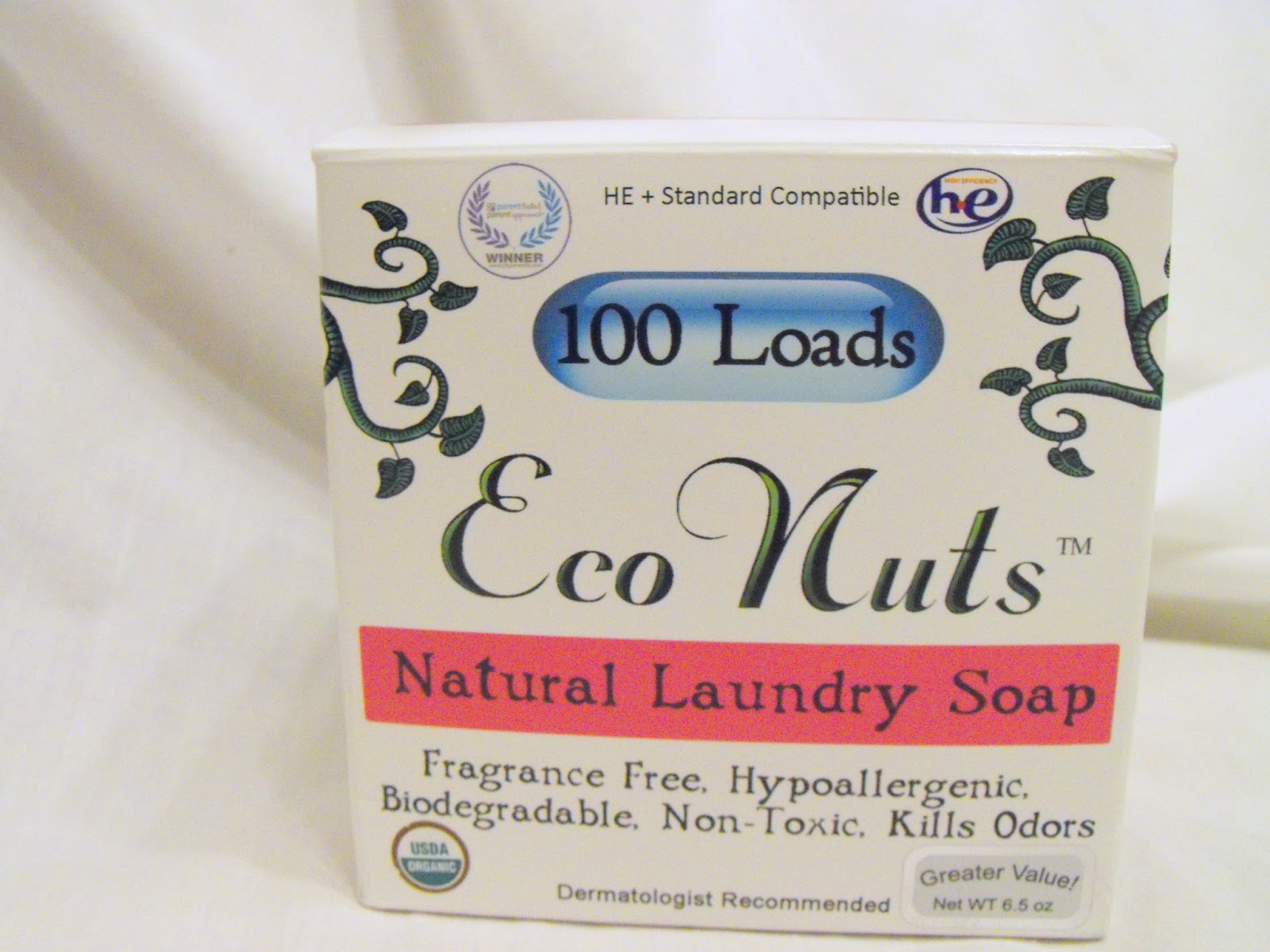
I bought my first batch of soap nuts from Amazon.  I had a $5 credit that was burning a hole in my pocket, so I purchased the 100 load box of Eco-Nuts.  It's a relatively small box packed full of these shiny, brownish-tan dried berries, along with 2 muslin sacks in which to place the berries. 
 
I just tried my first load of laundry, and I must say that I'm impressed!  The clothes came out clean, soft, and scent free straight out of the washing machine.  I did add a Gain fabric softener sheet to the dryer.  This is not necessary, as the saponin in the berries acts as a natural fabric softener; however, I have guys in my household, and let's just say that sometimes you NEED scented laundry. 

The berries work best in hot water or warm water but will also work in cold water, although there may not be as much saponin released.  So if you want to do a load of laundry in cold water but want to make sure there's enough saponin to ensure a clean load, try soaking or steeping the bag of berries in a cup of hot water for about 10 minutes prior to starting the wash load.  Then add the entire batch of water plus the bag containing the berries to the wash and proceed as usual.  

Overall, I thought they worked very well for a first- time use, and I am curious to see how well they work using them numerous times.  Regardless, this is a very economical and eco-friendly way to do laundry! 

Sunday, January 27, 2013

Laundry and Dishwashing Additives to Help Combat Hard Water


Have you ever done a load of dishes in the dishwasher only to have them come out spotty and with bits of food still on them after using your favorite dishwasher detergent?  Or have you done a load of laundry only to discover that your items just were not as clean as they need to be?  It's not a problem with your dishwasher or your washing machine.  It's also not a problem with your favorite dishwasher soap or laundry detergent... well, not technically.  

In 2010, a ban went into effect prohibiting the use of phosphates in dishwasher detergent.  It began in 17 states.  The phosphates were getting into the water supply and causing the growth of algae, so they were banned.  (Link HERE.)However, because of the expense associated with trying to manufacture one type of detergent for some states and a different type of detergent for other states, the manufacturers made the decision to just make one type of dish detergent:  phosphate free.  Phosphates were removed from laundry detergents in 1993.  

It's a win for the environment, but it's a loss for trying to get your dishes and laundry clean. Trisodium phosphate is a degreaser, soap scum buster, and left sparkling clean dishes and fresh laundry.  Unfortunately, once that was removed from these soaps, things were not good.  Pans came out dingy, aluminum turned black, fingerprints and lipstick were still present on dishes and glasses.  Some laundry soaps left clothes looking like they'd not even been washed.  Water could have done as good a job.  What's worse, if you live in an area of the country that has hard water, your dishes may have begun showing a filmy, milky, powdery residue, and your whites may have begun to be dingy.  

What can a person do?  Short of adding trisodium phosphate to these soaps, there are other options for combating these problems.  They are additives that can combat the minerals, metals, and other compounds found in water, allowing the detergents and soaps to do their jobs.  Here are some of them. 
 
Citric Acid -Citric acid is what makes lemon juice tart.  It has many uses not only in cleaning but in food and food preservation.  For cleaning, it serves as a chelating agent, binding to minerals and especially metals in hard water.  It makes an excellent additive to both the washing machine and the dishwasher.  It is the main active ingredients in dishwasher rinse aids such as LemiShine (If you want to read a fun chemist's breakdown of LemiShine, read the link HERE.)  Add 1-2 tablespoons to laundry to help laundry get cleaner, or add 1-2 teaspoons to your dishwasher for crystal clear glassware and spot-free dishes.  You don't have to buy LemiShine.  Instead, you can buy straight citric acid from places like Amazon.com, or find it in the canning aisle of your favorite grocery store, although buying it that way is quite expensive.  You can also buy it in bulk from Soap.com.  

Lemon Juice - Nature's own citric acid. (See note above.)  Add 1/4 cup to your laundry or dishwasher. 

White Vinegar - Acetic acid in water.  This is an excellent mild acid that dissolves calcium and makes it water soluble.  It is excellent for adding to laundry to increase the water's acidity.  It breaks down minerals contained with hard water, and it also helps to dissolve any residual soap scum left from laundry.  It is an excellent substitute for a fabric softener by adding it to the final rinse of a load of laundry.  Use anywhere from 1/2 to 1 full cup.  It is also a wonderful substitute for spotfree treatments in your dishwasher.  Just fill the rinse compartment with white vinegar and use as you normally would the rinse solution. 

Washing Soda - Sodium carbonate or soda ash.  Not to be confused with baking soda, which is sodium bicarbonate. Sodium carbonate bonds with magnesium and calcium ions in hard water and prevents them from bonding with detergent.  This allows the detergent to do its job and for your clothing to get cleaner.  It also raises the pH of water.  If you're a pool owner, you are familiar with The pH Plus product sold in stores to raise the pH.  Raising the pH also allows detergents to clean better.  (Link HERE.) Add approximately 1/4 to 1/2 cup to your laundry to help soften water and achieve better detergent results. 

Borax -  Sodium borate, sodium tetraborate, or disodium tetraborate.  Prevents calcium and magnesium from binding with detergent and rendering it ineffective.  (Link HERE.)  However, unless you use hot water, borax can be difficult to dissolve and can leave powdery granules in your washing machine, so it may not be your first choice to use if you have hard water.


Friday, January 25, 2013

Using Reason When Following Blog Posts

I have several bloggers and websites that that I follow, and I enjoy their posts and insights.  I am particularly fond of do-it-yourself or make-it-from-scratch posts.  I like the thrill of making something that is just as good as or comparable to something that is store bought.  It's even more thrilling if that item is significantly less expensive than store bought.  However, I've noticed a few things about some of these blogs.  The bloggers and writers find an idea on the internet, and they repeat it.  On and on and on.  If you were to do an internet search about making an item and use your favorite search engine, you will find post after post all repeating the same "recipe" or idea. 

Very few posts show much research to go along with the post.  No links to what an ingredient does, what purpose the whatchamacallit serves, how it mimics another product, etc.  In some posts, the recipe or item du jour seems like it would be a good idea but hasn't been truly tested.  Yet it gets passed on.  One blogger posted it, people raved about it, and then the next blogger posted it to rave reviews, and so on.  These posts talk about how brilliant the idea is, but there are very few commentators who actually post AFTER they tried whatever is mentioned in the post.  If they do, most are met with criticism and backlash from other commentators or even the writer of the post.  How dare they not follow the crowd?!!  Also, oftentimes a blog post may not be complete but simply links back to an original post on another blog.  I understand doing that.  We all want to give credit where credit is due and avoid presenting an idea as our very own.  That's honorable. However, many times the reposter hasn't tried the idea/item.  They just think it sounds neat so posted the idea themselves with a link back to the original.  It's as if back linking absolves them of any responsibility if the item/technique/recipe/whatchamacallit doesn't work.  

It's easy to jump on a bandwagon, though.  A reader looks at all those positive comments, rave reviews, and kudos for a popular post and thinks that it MUST be true.  It MUST work.  Sometimes a post is believed even when a reader has this little niggling doubt in the back of his/her mind.  That little voice might be saying, "This doesn't sound right," but we see all these positive comments and praise.  Then we shove that little voice aside and jump right in. 

My advice?  Listen to that voice!!  Do NOT take what is on a blog as gospel truth.  Be skeptical.  Seek truth. Research!  Even for MY POSTS here, please, be skeptical.  I am not an expert nor is anyone else out there unless they have a Ph.D. in whatchamacallits along with 40 years experience.  While I try to research and show my own personal outcomes via photos and such, some bloggers don't.  They repeat prior posts, and oftentimes don't show failures.  It takes other blogs showing failures to get an idea of how well some of these things don't work.  I can also personally attest to the fact that just because it appeared on a blog doesn't mean it really works!

I can think of two recent examples.  The first is a post by a local blogger/website owner that explained how to make your own fabric softener.  This recipe called for vinegar, baking soda, and essential oils.  The directions said to mix the vinegar and baking soda, wait until the bubbling stops, then add the essential oils for scent.  Store this concoction in a glass jar, then add to your laundry for a clean, fresh, softening scent in the place of liquid fabric softener. 

Sounds great and easy, right?  But wait!  Have you ever mixed baking soda and white or cider vinegar?  Besides creating a great volcano of froth and foam, do you know what you have left when the chemical process stops?  Water.  That's right.  Water with a very small amount of sodium acetate.  Here is a great article from Everyday Einstein that explains this process and how, really, you're not accomplishing much other than making some really neato, very mildly buffered water that has some smelly-good stuff in it.  You could have saved yourself some time and just put the essential oils in the laundry, but that wouldn't be as fun! 

Now, sometimes this bubbling/volcanic action is what you're looking for.  It's great for unclogging a drain, and it's also great for getting stains out of clothing or carpeting.  The bubbling action can work debris loose as a prewash.  I have no problem with that. It's the implication that the processed solution does anything snazzy.  Because, after all, you just created water, albeit fizzy water, and water is the best cleaner of all! It was just created in a rather spectacular way. 

Then I saw another post from another popular online blogger talking about how Epsom salts combined with essential oils makes a great substitute for Purex scent crystals.  NO!!!  Dear sweet crying baby Jesus... no!   Purex crystals contain scent, sodium chloride (table salt), bentonite (clay), and color.  List of ingredients HERE (click on the +fragrances, sizes, and ingredients link). Epsom salts are made up of hydrated magnesium sulfate.  As you can see, Purex crystals and Epsom Salts are definitely not the same!  

If you add Epsom salts to water, you are, in essence, creating hard water.  Hard water contains calcium and magnesium and other dissolved minerals and metals.  Your detergents, soaps, and other things you add to your laundry to get items clean will not work very well in hard water. Why would you want to create hard water?  Especially if you already have hard water?   Adding Epsoms salts to the laundry will do just that! It will worsen an issue, not make it better.  With a little research, the blogger would have known that.  However, there was the post, bigger than daylight, with all these comments praising the brilliance of this new use for an old product. 

These are just two examples of blog posts that look like they are fantastic but when researched reveal that they either won't do much, if anything, and might even make things worse. Why these bloggers, both of whom are very popular, failed to actually research is beyond me.  Now, maybe they just like what they made and like using it.  That is perfectly fine.  I'm all for it because everyone has a right to do as they please.  However, I think it's also a great example of reader beware.  Just because you read it on the internet doesn't make it true! 


Thursday, January 24, 2013

Beer Bread - Broke Food

Beer bread is an excellent quick bread that has just a few ingredients.  Bake it, allow it to cool, and it is great to have with sandwiches or make an egg batter and turn it into French toast.  We like this as just a bread to snack on with real butter and honey.  It also is a great budget stretcher if you're coming up on the end of the week and need bread to go with meals or make sandwiches. 

The recipe calls for Bisquick, but you can also use a substitute for that, which I will list below.  There are only 3 ingredients (my favorite kind!), and it's easy to whip up a batch and have it ready for your next meal.  

Beer Bread 
4 cups Bisquick (this equals one 20 oz. box)*
4 teaspoons sugar 
1 12 oz. can of beer

*If you do not have Bisquick, use 4 cups all-purpose flour, 1 Tablespoon baking powder, 1 teaspoon salt.  

Mix ingredients in a  mixing bowl until it forms a sticky batter. 
Pour into a loaf pan and allow to set for approximately 30 minutes.  This may or may not rise.  Your mileage may vary.  
Bake at 375 degrees for approximately 30-40 minutes or until loaf has risen and turned a golden brown.   
Allow to cool for approximately 10-15 minutes, then remove from pan and allow to cool completely before slicing.